

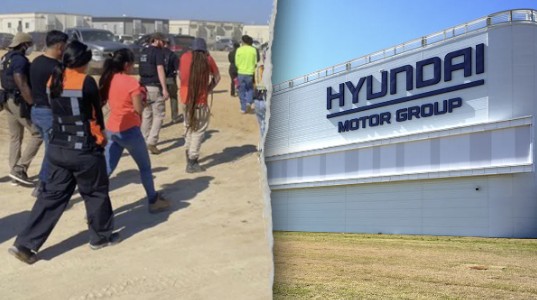
Joe Biden slid a cool $5 billion into the pot as his slick South Korean partner named Hyundai dealt the cards.
“This’ll create thousands of American jobs, folks—good ones, family-supporting gigs in the heart of Georgia,” declared a confident Biden. But then, the next card flips and the newly elected Donald Trump fooled everybody, including the crooked dealer. ICE raided the game and suddenly the whole table is exposed as a house of cards built on undocumented aces.
Welcome to the ultimate governmental gaffe, where your tax dollars funded a factory that’s less “Made in America” and more “Smuggled Through the Back Door.”
This Hyundai situation in Alabama isn’t just another Washington whoopsie; it’s a masterclass in irony that could make even the most jaded comedian jealous. We’re talking about the Hyundai-LG Metaplant in Ellabell, Georgia—a sprawling electric vehicle battery facility touted as a cornerstone of Biden’s Inflation Reduction Act.
Back in 2022, during a presidential pit stop in South Korea, Biden beamed as Hyundai pledged over $5 billion in investments, with the U.S. chipping in billions more in subsidies and tax credits to lure them stateside. The goal? 8,100 new jobs in Bryan County, powering EVs and supposedly juicing the local economy like a supercharged Tesla.
It was pitched as a win-win: Foreign expertise meets American grit, all under the banner of “Buy American, Hire American.”
Except, as we now know, the hiring part got lost in translation—or perhaps deliberately ignored.
Fast-forward to September 5, 2025, and enter stage right: The largest single-site immigration raid in Homeland Security history.
ICE agents descended on the plant like avenging angels with clipboards, detaining up to 475 individuals—nearly 40% of the 1,200-person workforce. Who were they? Mostly South Korean nationals, some overstaying visitor visas like forgotten houseguests, others allegedly slipping across borders without so much as a “howdy.”
Hyundai, quick to distance itself, insisted these weren’t direct employees but subcontractors’ hires. Does it matter? Where does the buck stop, Song-Ju?
The raid uncovered a web of expired visas, fraudulent documents, and outright undocumented status, turning what was supposed to be a beacon of Biden’s green agenda into a spotlight on lax enforcement.
President Trump backed the raid but added, “We need foreign experts to train Americans,” suggesting temporary legal stays for skilled workers.
It’s a nod to reality amid the rhetoric—enforce the law, but don’t torch the tech transfer.
But here’s where the sarcasm simmers: Biden’s administration poured billions into this venture as part of a broader push to onshore manufacturing and combat climate change. The Inflation Reduction Act, that $369 billion behemoth, dangled tax credits and grants to companies like Hyundai and LG, insisting on domestic content and union-friendly labor.
Yet, under their watch, the plant became a haven for undocumented labor, depressing wages and sidelining American citizens. Hypocrisy? It’s like preaching veganism while enjoy a top sirloin steak—medium rare, with extra butter. The very policies meant to “lower costs for Americans” ended up subsidizing a system where illegals undercut pay scales, all while taxpayers footed the bill for the privilege.
To grasp the full absurdity, let’s rewind the tape for some historical context.
This isn’t America’s first rodeo with subsidized foreign ventures gone awry. Flash back to 1986, under Reagan: The Immigration Reform and Control Act granted amnesty to nearly 3 million undocumented immigrants, promising it’d curb future influxes by cracking down on employers.
It didn’t. Instead, it signaled to businesses that cheap, exploitable labor was here to stay. Fast-forward through the ’90s and 2000s—Clinton’s NAFTA opened trade floodgates, Bush’s guest worker proposals fizzled, and Obama’s DACA deferred deportations while subsidies flowed to solar firms like Solyndra, which infamously collapsed amid scandals but also relied on low-wage immigrant labor in related sectors.
By the Obama-Biden era, the pattern was set: Billions in green energy handouts, from wind farms to battery tech, often built on the backs of undocumented workers in agriculture, construction, and manufacturing. A 2014 Federal Reserve analysis highlighted how immigrants, including illegals, fill low-skill gaps but create fiscal drags through welfare and education costs—essentially a hidden subsidy to corporations.
Biden’s team turbocharged this. His administration’s lax border policies—catch-and-release, sanctuary expansions—saw migrant encounters skyrocket to over 10 million since 2021.
In critical sectors like EVs, where the U.S. lags behind Asia, subsidies were dangled without rigorous enforcement. Hyundai’s Georgia plant? It snagged $2.1 billion in state incentives alone, on top of federal largesse, all while allegedly turning a blind eye to visa violations.
Reports from the raid indicate many detainees were skilled engineers on improper visas, flown in to bootstrap the facility before it even opens in late 2025.
South Korea’s government cried foul, calling it an “unfair infringement,” but let’s call it what it is: Accountability finally knocking.
Trump’s 2024 victory? That’s the plot twist that uncorked the bottle. Pre-election, Biden’s ICE was more mascot than enforcer, with raids rare and resources stretched thin. Post-win, the gloves came off: Mass deportation plans ramped up, with over 1.6 million self-deportations encouraged via incentives like $1,000 flights home.
Suddenly, revelations poured out—Venezuelan gangs in Colorado apartments, migrant surges overwhelming Ohio towns, and now this Georgia gem.
Trump’s stance isn’t “hard”—it’s legal, a return to sovereignty that boosts wages and resources for citizens.
Studies show undocumented labor suppresses pay by 3-5% in low-skill jobs, while enforcement could add billions to GDP by prioritizing Americans. Opening these roles to locals could spark real economic uplift, not the subsidized shadow economy Biden enabled.
Bolstering this musing, consider the broader implications for Trump’s immigration crackdown. By mid-2025, deportations have surged. And while polling shows mixed reviews, I put no faith in those polls. The court of public opinion shows most people in favor of getting rid of illegals.
Economists argue immigrants fuel growth, contributing $9.8 billion in taxes annually.. However, the counterpoint is clear: When subsidized by taxpayers and unchecked, it distorts markets. Hyundai’s fallout? Shares dipped, suppliers scrambled, and South Korean firms reeled—proof that enforcement has teeth.
Without Trump’s win, this Hyundai hypocrisy stays buried. Biden’s “Build Back Better” thankfully morphed into “Build Back Borders” No longer can foreign companies pocket U.S. cash and flout our laws.
In the end, this saga isn’t just about one plant; it’s a wake-up call on illegal immigration’s economic entanglements. As mass deportation 2025 unfolds, expect more exposures, more debates, and hopefully, policies that put America first—without the ironic subsidies.