

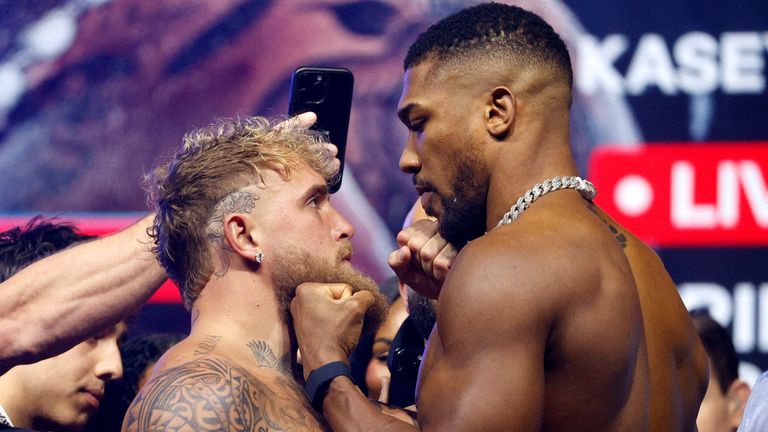
I must admit, I’m sick of Jake Paul fights. Not bored. Sick. There’s a difference.
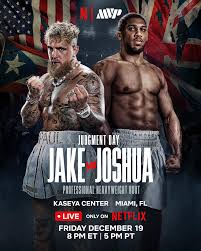 Boredom implies mild indifference. Sickness implies nausea, a sense that something once amusing has curdled into performance art funded by Pay-Per-View.
Jake Paul didn’t just find a lane, he set up toll booths, traffic cones, and a gift shop selling irony. And no, I’m not mad at him for figuring out the hustle. Capitalism rewards ingenuity, not purity. But this should have ended already. Actually, it should have ended with the Tyson fight, which itself felt like a late-night sketch that went on three minutes too long. Instead, Paul pushed it one fight too far, and Anthony Joshua was kind enough to pull the plug.
Before you ask why I’m commenting on something I want to go away, understand this isn’t really about boxing. It’s about money. Boxing is just the carnival ride that gets you to the cashier.
That said, I’m not done roasting Jake Paul, because imagining his next opponent is comedy fuel.
His fights have always leaned harder into sensationalism than pugilism. This isn’t Ali versus Frazier. It’s more like WWE with mouthguards. If I had to guess who’s next, maybe George Foreman’s hologram, sponsored by an energy drink and a nostalgia algorithm.
After watching Joshua’s stunning knockout, I honestly can’t imagine anyone paying real money to see another Jake Paul fight that pretends to be serious. The spell broke. The audience saw behind the curtain. The wizard was just a guy with good lighting and a YouTube channel.
And that brings me, mercifully, to the money.
According to reports, each fighter walked away with roughly $92 million.
Let that number marinate. Based on the actual duration of the fight, that’s about $93,023 per second or $5.58 million per minute. This is the moment where I stare into the middle distance and ask myself why I didn’t pursue a kickboxing career. I can hear Fred Sanford clearing his throat from the beyond: “You big dummy!”
For $93,000 a second, I would happily go a round with, well… anyone. $15 million for one round. Absolutely.
After taxes, I could cover medical bills, physical therapy, emotional counseling, and still retire as a legend in my own living room.
Speaking of taxes. Ouch
I learned how thoroughly Anthony Joshua got worked, not by Jake Paul, but by governments.
Here’s where the romance of prizefighting meets the fluorescent lighting of bureaucracy. According to AceOdds, about 37 percent of Joshua’s winnings, roughly $34.4 million, went straight to the IRS. Joshua is British, but Uncle Sam still wanted his cut because the fight took place in America. Trump got his. Sadly for DeSantis, Florida doesn’t have a state income tax, so at least Joshua was spared that additional indignity. Small mercies.
Then Britain stepped up to the plate for their slice.
After the U.S. finished carving up the pie, HMRC, Britain’s version of the IRS, lined up for another $7.5 million, calculated mercifully after America took her cut.
But Britain wasn’t finished.
Joshua also owed around $1.9 million to National Insurance contributions, Britain’s equivalent of Social Security. Add it all up and Joshua’s total tax bill comes in around $43.8 million. Nearly half his purse vanished into government accounts. Don’t bother asking if he’ll ever see meaningful benefits from that one-time National Insurance deposit. It works just like our Social Security system. High earners pay in so the state can redistribute with enthusiasm and little gratitude.
Honestly, if Joshua doesn’t have a girlfriend or a wife, it’s because he doesn’t need one. On fight night, he got screwed three times before he even left the ring.
No bureaucrat threw a punch. None of them promoted the fight. Nobody taped Joshua’s wrists, offered a pep talk, or took a right hook to the jaw. Yet they walked away with nearly $43.8 million. That’s the kind of efficiency only government can achieve.
If I knew a payday like that was coming, I’d be shopping for a new passport faster than Jake Paul shops for celebrity opponents. Hold the fight in the UAE. No income tax. Big venue. Global audience. Same spectacle, far less pillaging. I’m not advocating tax avoidance in the cartoon villain sense. I’m just saying when one fight pays your taxes and social security for ten lifetimes, the system might be a little… ambitious.
Does anyone seriously think either country will give any of that money back? Jake Paul left with a broken jaw and missing teeth. Is there a form for that? A box you check labeled “Got obliterated on live television by a professional heavyweight”? No deductions. No credits. Just ice packs and memories.
To be clear, both fighters made enough money to last multiple lifetimes.
The average worker earns about $1.5 million over their entire career. Joshua and Paul made that every few seconds. If they’re even mildly competent with money, they’re set forever. So are two governments.
Jake Paul is, at heart, a journeyman fighter who finally fought a real boxer. And it showed. He deserves credit for building a cult of personality, borrowing liberally from the Kimbo Slice playbook, and cutting out the middleman. Social media replaced promoters. Manufactured beef replaced legacy. On that front, he played it brilliantly. I applaud the business model.
But I’m also glad he finally took a real fight. And the result was exactly what meritocracy looks like when you strip away hype. I’ve watched the one-two combination that dropped Paul at least twenty times. It was more than flashy. It was precise.
Years of elite training distilled into a few seconds of inevitability. That’s what mastery looks like when it collides with marketing.
So yes, maybe this is my meritocracy showing. The circus met the lion. The influencer met the craftsman. And the loudest applause might belong to the tax collectors, who once again proved they never miss a main event.