

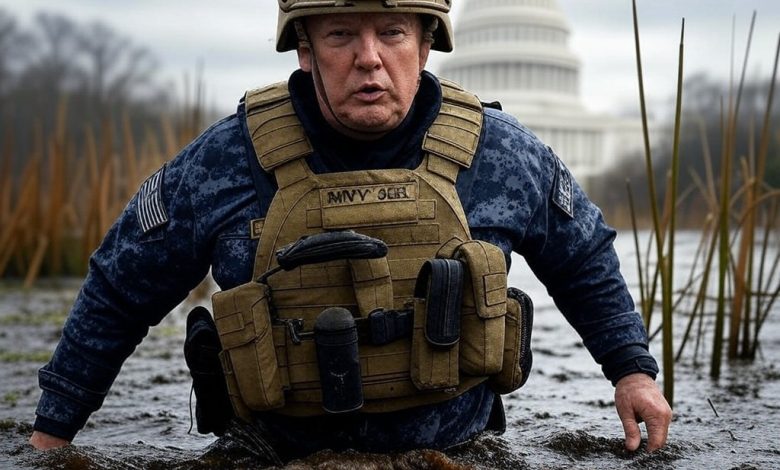
The U.S. raid on Venezuela that night wasn’t just another “special operations success.” It was a grandmaster move on the global chessboard — a sudden, followed by a sweep so clean it made white gloves jealous. And the world is still figuring out what it saw.
“Lights Out” Wasn’t a Power Surge
Let’s start with the thing that’s gotten arms-industry analysts whispering into their coffee machines: Before the first drone buzzed in, Venezuela’s radar, communication, and early-warning networks went dark. Not because of electrical gremlins, but because U.S. forces effectively severed the enemy’s nervous system before the raid even began. This wasn’t a gadget used once — this was the orchestration of effects across cyber, electromagnetic, and space domains to make defensive networks useless.
This is no small thing. Modern air defenses aren’t just missiles — they’re sensors, networks, and computers feeding one another a constant diet of threat data. Once you mute the data stream, those systems become glorified metal lawn ornaments. That’s what happened here.
Growlers and “Magic Waves”
Most of the world has heard of stealth aircraft and precision bombs — those are the headline acts. But the real headliners in this story are things that usually don’t make the evening news: electronic warfare jets like the Boeing EA-18G Growler that jam radars and scramble comms into digital jam.
Beyond that, there’s a dramatic, unverified but widely circulated firsthand account claiming U.S. forces used something akin to a directed energy effect — described as an intense wave that left defenders incapacitated with nosebleeds and unable to fight. Whether it was a sonic or electromagnetic device, the bottom line is the same: U.S. forces wielded effects that felt to the defenders like something completely alien.
That’s the kind of capability that isn’t announced at defense expos. It’s the kind your adversaries don’t want you to know they don’t have yet.
Russia and Ukraine: A Cautionary Miracle
Across Europe, military experts watching Ukraine have been witnessing a grinding, attritional conflict for years where advanced defenses and layered anti-air systems have actually worked — at least relatively. But now they’ve watched a different script unfold.
In Venezuela, Russia’s own air defenses — the S-300, Buk, Pantsir, and others — didn’t down a single U.S. aircraft and were effectively bypassed or blinded. Was it poor logistics or training? Maybe. But the larger inference abroad is raw: In the wrong conditions, even high-end Russian kit can be rendered irrelevant when the sensor network is neutralized first.
If you’re Vladimir Putin and your prized export systems just got made to look like chunky paperweights, you feel that. American allies fighting in Eastern Europe might also take a quiet sip of satisfaction. For Russian planners, Venezuela served up a sobering thought: superior kit isn’t enough without superior networking and electronic dominance.
And here’s the punchline: Russia didn’t manage a Venezuela-style decapitation in Ukraine, and if they tried, analysts insist they’d struggle because their coordination and readiness aren’t at the same level. In fact, one recent assessment explicitly points out that China — often linked to Moscow — also lacks the precise, multi-domain command needed for operations of this sort.
China and Taiwan: Not So Fast, But Definitely Watching
Now let’s draw it westward across the Pacific. Imagine this raid was a midnight poker reveal — not only did the U.S. show its cards, it made every other player squint and go: what was that?
China’s leadership, fixated on Taiwan, didn’t respond with jets and missiles. Analysts say the Venezuelan raid may embolden Chinese territorial rhetoric but probably won’t spark an immediate attack on Taiwan. That’s because an amphibious invasion or airborne decapitation isn’t that same precise, rapid, electronically dominant operation. Geography, early warning layers, and U.S. alliances make Taiwan a vastly different battlefield.
But China is watching. Beijing’s military modernization has been about networked capabilities, from naval strike groups to integrated air defenses. And what they just saw — radar arrays jammed into oblivion, weapons systems silenced, and hundreds of defenders rendered non-combatants by a strange energy event — sits in recruiting halls and strategy cells like a cold splash of realization: their radars alone won’t save them.
They may not invade Taiwan tomorrow, but they’re now recalibrating assumptions — which is exactly what Trump’s military machine signaled with this raid.
If Biden Tried This…
Let’s suspend disbelief for a second and imagine Joe Biden standing in the Situation Room, reading off cue cards about mysterious hacker emojis and accidentally ordering French fries instead of a raid. This would not be the outcome.
Under Biden, the U.S. would be tied up in international law committees, apologies to every country with a podium, and day-long Senate hearings about “de-escalation” — while Russia and China snicker into their tea. Trump’s approach was surgical, quick, and decisive — a recipe that demonstrates capability rather than debates it. The difference between debate and demonstration is the difference between asking for permission and commanding respect.
What the World Took Away
From Moscow to Beijing, Caracas to Kyiv, here’s what the Venezuela raid broadcast:
1. Radar is only as good as the data feeding it. If that’s cut, radar is just blinking lights on a desk.
2. Electronic dominance is now king. You can deploy missiles and fighters all day, but if the enemy kills your command and control first, you’re fighting blind.
3. Small, elite forces with overwhelming tech can rout masses. A few dozen operators overcame hundreds — not by brute force, but by effect dominance that makes resistance irrelevant.
4. America’s adversaries now have to plan for a world where the U.S. can isolate and neutralize their defenses before they even know a fight began. That’s a psychological ripple, not just a military one.
The Bigger Trump Signal
You can scold, you can condemn, you can hold UN sessions about “crime of aggression” all you like — and the world will watch the soap but remember the message. Countries like China and Russia bristled at Trump’s move. They publicly called it illegal. But privately? Now they’re recalculating, because the days of cocksure posturing may be numbered if the U.S. can turn off your senses before you shoot back.
Neither Obama or Biden ever demonstrated a capability like this in a way that reframed global deterrence overnight. With this raid, Trump’s military didn’t just capture a dictator — it showcased what happens when you combine surgical precision, information dominance, and sheer audacity. And that’s the kind of thing adversaries hesitate to test.
So while the rest of the strategic world squints at satellite feeds and defense budgets, one thing’s clear:
Trump’s raid didn’t just topple a tyrant — it made every radar operator in Moscow and Beijing check their screens twice.