Politics, much like Hollywood, survives on illusion.
Sets look like cities, scripts pretend to be spontaneous, and audiences are asked to suspend disbelief long enough to buy popcorn and applaud. But occasionally the stage lights flicker, the painted skyline tilts, and someone from backstage walks out holding the financial ledger instead of the script. That moment just arrived for California Governor Gavin Newsom.
And the man delivering the reality check was not a Republican critic, not a conservative pundit, and certainly not a Trump rally crowd chanting nicknames. It was Democratic mega-donor John Morgan, a man whose wallet has historically spoken fluent Leftism, suddenly announcing that Newsom’s presidential ambitions are, in his words, “dead in the water.”
When the people funding the orchestra start unplugging instruments, the music is over.
The Collapse Nobody Was Supposed to Notice
Democrats find themselves approaching 2028 with a peculiar problem. Their bench looks deep only if viewed from very far away, preferably through frosted glass. Up close, the party resembles a political clearance rack where every item carries a defect label voters already recognize.
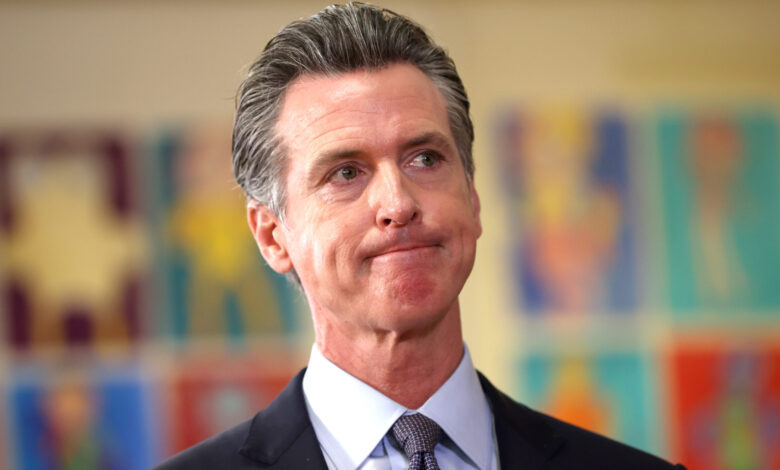
Governor Hairdo has long imagined himself the heir apparent. The polished salesman of progressive governance, affectionately called “Newscum” by President Trump delivers speeches as though auditioning for a streaming-service biopic about himself. Yet governing is not cinematography. It leaves data, outcomes, and consequences, all stubbornly resistant to spin.
Morgan’s critique landed with particular force because it echoed what ordinary Americans have observed for years: California under Newsom has become less a model and more a warning label.
Homeless encampments stretch across major cities despite billions spent on solutions. State audits have revealed enormous inefficiencies and questionable outcomes in homelessness programs, undermining claims that compassion paired with spending automatically produces results. Meanwhile, crime trends worsened following reforms such as Proposition 47, which reduced penalties for certain theft offenses, contributing to retail losses and public frustration.
These are not conservative talking points anymore. They are bipartisan acknowledgments whispered increasingly loudly.
And whispers, once financed by donors, tend to become headlines.
When Money Talks, Ideology Listens
Political donors are not philosophers. They are investors. Their loyalty lasts precisely as long as the return on investment appears plausible.
John Morgan’s assessment matters because donors typically protect party narratives until the last possible moment. Public criticism from within signals something deeper than disagreement. It signals fear that the brand itself has become radioactive.
Morgan essentially argued that Newsom cannot sell nationally what voters already associate with decline locally. California’s challenges, including rising homelessness, persistent affordability crises, and a projected multibillion-dollar budget deficit, are no longer regional quirks. They have become case studies cited across the country.
Democrats spent years marketing California as the future. Voters looked at that future and quietly booked one-way U-Hauls.
Population outflow from California to states like Texas and Florida has been widely documented, driven by taxes, cost of living, regulation, and energy costs. Businesses followed families, and investment followed businesses, creating a migration pattern that reads less like coincidence and more like a referendum.
You cannot campaign on a success story when your citizens are fleeing the sequel.
The “California Dream” Meets Spreadsheet Reality
For decades, California represented aspiration. Hollywood glamour met Silicon Valley innovation, wrapped in sunshine and opportunity. Newsom inherited that mythology but governed during its unraveling.
Housing prices climbed into the stratosphere, transforming middle-class stability into a luxury item. Energy policies increased costs while reliability concerns persisted. Tech companies, once inseparable from the state’s identity, began exploring friendlier regulatory climates.
The modern Democratic pitch requires voters to believe that outcomes contradict lived experience. Newsom’s challenge is that Americans possess eyes, bank accounts, and relatives who moved to Scottsdale.
Political branding works only until reality starts itemizing receipts.
Morgan’s criticism exposes a deeper fracture within the Democratic coalition: donors and activists increasingly operate in separate realities. Activists prioritize ideological purity; donors prioritize electability. When those collide, ideology usually loses because campaigns run on money, not hashtags.
Trump’s Shadow Over 2028
President Donald Trump’s enduring political presence adds another complication for Democrats. Trump reframed political debate around results rather than rhetoric. Thus, he forces opponents to defend measurable outcomes rather than aspirational messaging.
Nicknames aside, Trump’s critique of Newsom resonates because it simplifies a complex argument into a gut-level observation: if California represents progressive success, why are people leaving?
The question sticks precisely because it requires no policy briefing to understand.
Newsom’s national ambitions depend on persuading voters that California’s struggles are anomalies rather than consequences. Morgan’s remarks suggest even insiders no longer believe that argument can survive a general election spotlight.
And elections, unlike press conferences, allow voters to interrupt.
The Party That Cannot Self-Reflect
One of the enduring mysteries of modern Democratic politics is its resistance to introspection. Failure rarely triggers course correction; instead, it produces messaging adjustments, rebranding efforts, or new terminology meant to rename old problems.
Crime becomes “perception.” Inflation becomes “transition.” Border crises become “complex humanitarian challenges.”
Eventually, language inflation meets voter exhaustion.
Morgan’s critique stands out because it breaks the unspoken rule: never admit failure publicly. His comments imply that at least some Democrats recognize the electoral danger of doubling down on policies voters associate with disorder and economic pressure.
Whether the party listens is another matter entirely.
Political movements rarely change direction until defeat becomes unavoidable. Even then, they often search for scapegoats instead of solutions.
Old Ideas in New Packaging
Newsom represents something older than his carefully styled image suggests. His political philosophy traces back through decades of progressive governance that prioritized intention over outcome, symbolism over sustainability.
There is nothing new about promising sweeping transformation while downplaying unintended consequences. The formula predates Newsom by generations.
What is new is voter skepticism.
Americans now compare states in real time. They see economic growth patterns, tax burdens, crime statistics, and migration flows without relying solely on media interpretation. Information travels faster than narrative management.
The result is political transparency forced by comparison. And comparison has not been kind to Newsom’s record.
The Quiet Democratic Realization
Morgan may simply be the first donor willing to speak openly. Others likely share his calculation privately: nominating a governor whose state serves as conservative campaign material might be strategically unwise.
Donors rarely abandon potential nominees early unless internal polling looks grim. That reality suggests Democratic insiders already understand what public commentary only hints at.
Newsom’s greatest obstacle is not Republican opposition. It is Democratic doubt.
When your own allies begin describing your candidacy as impossible, the campaign hasn’t started yet, but the ending has already leaked.
A Moment of Truth… or Another Illusion?
The larger question extends beyond one governor’s ambitions. It asks whether Democrats are capable of reassessing policies that produce outcomes voters reject.
History suggests skepticism is warranted.
Political parties tend to reform only after undeniable defeat forces reinvention. Until then, they continue auditioning new messengers to sell old ideas, hoping charisma can substitute for results.
John Morgan’s remarks represent a rare crack in that strategy, a moment when financial realism interrupted ideological theater.
Whether Democrats treat it as a warning or merely an inconvenience will shape the road to 2028.
But one truth now hangs unmistakably in the air: when even the people funding the narrative stop believing it, the story is already over.