

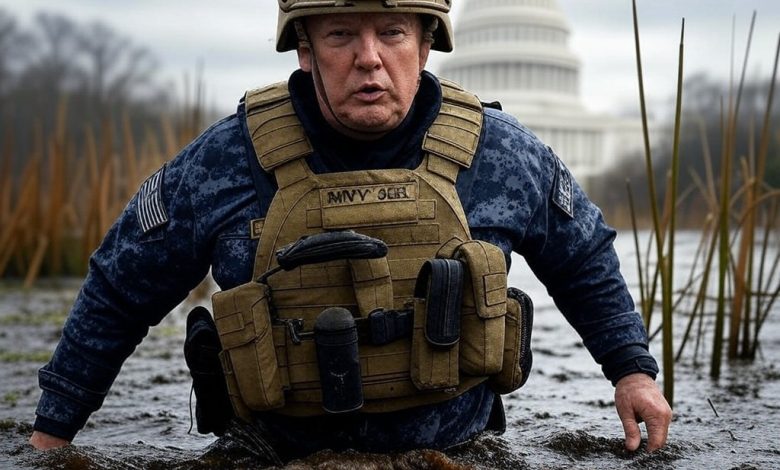
There are moments in history when policy stops sounding like a press release and starts sounding like rotor blades in the dark.
For years, Americans were told the drug crisis was complicated, nuanced, sociological, systemic, and wrapped in enough academic vocabulary to qualify for its own graduate degree. Meanwhile, fentanyl poured across the border with the efficiency of Amazon Prime, cartels evolved into multinational corporations with better logistics than FedEx, and Washington held hearings that produced sternly worded disappointment.
Then something unusual happened. Someone treated the cartels like enemies instead of misunderstood entrepreneurs.
When President Donald Trump declared Mexican drug cartels to be narco-terrorists, the political class reacted as though he had proposed outlawing gravity.
Critics gasped. Commentators clutched pearls so aggressively they nearly achieved carbon compression. Yet the designation carried one unavoidable implication: terrorists are not negotiated with, managed, or politely discouraged. They are dismantled.
And dismantling has consequences.
According to reporting highlighted in this coverage of the joint U.S.–Mexico operation, American cooperation helped lead to the takedown and death of Nemesio Oseguera Cervantes, better known as El Mencho. Cervantes was the leader of the Cartel Jalisco Nueva Generación (CJNG), an organization that long ago graduated from “drug gang” into something closer to a private military enterprise.
CJNG wasn’t merely selling narcotics. It operated armored convoys, deployed drone explosives, controlled territory, and influenced governments.
The Fiction of the Old Drug War
America has technically been fighting a war on drugs since the 1970s. However, in reality, previous efforts resembled a treadmill set permanently to “symbolic effort.”
Politicians delivered speeches. Agencies issued reports. Funding increased. Drugs became cheaper, stronger, and more accessible every single decade.
That contradiction was rarely examined because doing so required asking an uncomfortable question: who benefited from failure?
Cartels certainly did. But they were not alone.
Entire political careers were built on managing the crisis rather than ending it.
Bureaucracies expanded. Advocacy industries flourished. Consultants consulted. Meanwhile, overdose deaths climbed with grim consistency, turning American cities into cautionary tales disguised as policy experiments.
The genius, and controversy, of Trump’s approach lies in its simplicity. By labeling cartels as terrorist organizations, he changed the legal and operational chessboard overnight. Intelligence sharing expanded. Financial warfare intensified. Military tools previously off-limits entered the conversation.
The message was unmistakable: trafficking poison into America would now carry geopolitical consequences.
When Business Models Meet Missiles
Cartels operate like global corporations. They diversify supply chains, hedge risk, exploit regulatory gaps, and partner with corrupt officials wherever governance is weak enough to rent.
Trump’s earlier targeting of Venezuelan drug routes demonstrated this philosophy. Interdicting narcotics shipments was not merely about drugs; it was about collapsing revenue streams that sustained criminal regimes. When Venezuelan networks were pressured, the signal traveled far beyond the Caribbean: the United States was willing to treat narcotics trafficking as national security warfare.
That distinction matters.
Because once drug trafficking becomes a security issue rather than a public health talking point, the response changes from seminars to strategy.
The Maduro regime learned this lesson firsthand. Long accused of functioning less like a government and more like a distribution hub with a flag, Venezuela represented the fusion of state power and narcotics economics. Trump’s policies reframed such actors not as diplomatic inconveniences but as adversarial participants in organized harm against American citizens.
Suddenly, the drug trade was no longer an abstract tragedy. It was hostile action.
Mexico’s Moment of Decision
For Mexico, cooperation in the operation against El Mencho represents more than a tactical victory. It signals a strategic crossroads.
For decades, Mexico faced an impossible balancing act: confronting cartels risked internal destabilization, while tolerating them eroded sovereignty. Previous U.S. administrations largely accepted this stalemate, preferring diplomatic calm over decisive disruption.
Trump altered that equation by applying pressure not only on criminal organizations but on governments themselves. Partnership became conditional. Economic and security relationships carried expectations.
In essence, Mexico was presented with a binary choice: align against the cartels or risk being treated as adjacent to them.
Recent cooperation suggests the answer.
The Political Ripple Few Want Discussed
Here is where the story becomes awkward for many longtime observers.
Cartels do not thrive in isolation. They flourish in ecosystems of selective blindness. For decades, politicians across the hemisphere campaigned on compassion while quietly tolerating the infrastructure that enabled trafficking. Enforcement failures were explained away as complexity, even as illicit money flowed through legitimate systems with suspicious ease.
When cartel revenue shrinks, it does not only hurt criminals. It disrupts networks of influence built on looking the other way.
That reality explains why aggressive anti-cartel policies generate such intense political resistance. Ending the drug trade threatens more than smugglers; it threatens narratives, alliances, and financial pipelines that have existed comfortably beneath public scrutiny.
The silence following successful operations often speaks louder than the criticism that preceded them.
Lives Measured in Absence
Policy debates tend to count visible outcomes. Arrests. Seizures. Headlines.
The true measure of anti-drug success is invisible: the overdoses that never occur, the funerals never scheduled, the parents who never receive late-night phone calls from hospitals.
If supply chains are disrupted, encounters between dealers and users decrease. Fewer encounters mean fewer opportunities for fatal doses. Even incremental reductions translate into thousands of saved lives over time.
America will not eliminate addiction overnight. No serious observer believes otherwise. Human weakness predates borders and policies alike. But reducing availability changes trajectories, buying time for recovery instead of surrendering communities to chemical fatalism.
Every long war begins with a moment when one side realizes the rules have changed.
CJNG: The Army Disguised as a Cartel
CJNG represented the evolution of organized crime into hybrid warfare. Its operations included propaganda campaigns, paramilitary tactics, and international expansion strategies typically associated with insurgent movements.
Trump recognized something many policymakers resisted admitting: modern cartels are insurgencies financed by consumer demand. Thus, treating them as terrorists was not rhetorical excess. It was operational accuracy.
And once that recognition took hold, the response shifted accordingly. Intelligence agencies, financial regulators, and military planners began operating from a unified premise: this was not crime management. It was conflict.
A Message Heard Worldwide
The global signal is unmistakable.
Do legitimate business with the United States or traffic poison into its communities. Doing both is no longer an option.
Nations facilitating narcotics networks face isolation. Organizations targeting American consumers face annihilation. The cost-benefit analysis for traffickers has changed dramatically, replacing predictable profits with existential risk.
Markets adapt quickly when survival enters the spreadsheet.
The Long War Ahead
No single operation ends a drug war. Removing one kingpin creates power vacuums, succession battles, and temporary instability. Cartels mutate; new leaders emerge; routes shift.
Sustained pressure will require intelligence coordination, special operations capabilities, financial surveillance, and relentless diplomatic leverage. It demands patience measured not in election cycles but in decades.
Yet momentum matters.
For the first time in years, cartel leadership must consider whether targeting American markets invites consequences beyond arrests. Fear, long monopolized by traffickers, may finally be traveling in the opposite direction.
Americans in Mexico were reportedly advised to remain cautious during operations, a reminder that real enforcement carries real risk. But it also underscores a renewed doctrine: if American citizens are harmed, retaliation will not be symbolic.
It will be decisive.
The war is far from over. Cartels remain wealthy, adaptive, and ruthless. Addiction remains a national struggle. But the era of pretending the problem could be solved through conferences and compassion slogans appears to be ending.
And somewhere, in boardrooms disguised as criminal empires, accountants are recalculating projections under a new variable they had nearly forgotten existed.
Consequences.