

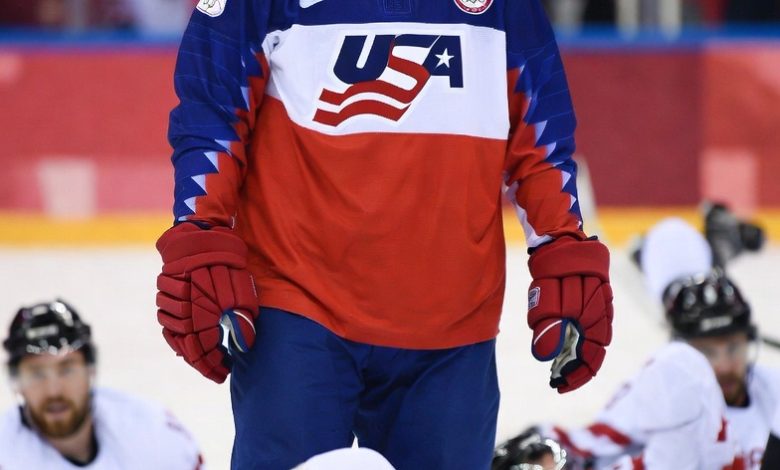
There are moments in history when a sporting event escapes its cage and starts wandering into geopolitics wearing shoulder pads.
Most games remain safely confined to statistics and highlight reels, but occasionally one grows legs, grabs a microphone, and begins lecturing nations about pride, power, and psychology.
This was one of those moments.
America beating Canada in Olympic men’s hockey should have registered somewhere between “nice win” and “pass the nachos.” Instead, it detonated like a cultural fireworks factory tipped into a bonfire. Canadians reacted as though the United States hadn’t merely won a game but had repossessed their national personality.
Which, in fairness, might explain the emotional response.
Canada has long treated hockey not simply as sport but as identity infrastructure.
The country exports maple syrup, politeness, and defensemen with missing teeth. Hockey is the one arena where Canada assumes unquestioned superiority, the family heirloom nobody else is allowed to touch. Americans dominate finance, technology, entertainment, and military power, while Canadians keep hockey as proof that geography still hands out participation trophies.
So when Team USA won, something deeper cracked.
Because this loss arrived at a politically inconvenient moment.
For years, Canada’s leadership under Justin Trudeau positioned the country as the moral supervisor of the Western world, a polite hall monitor wagging its finger southward. America, particularly during and after the presidency of Donald Trump, was framed by Canadian elites as reckless, uncouth, and in need of enlightenment via government expansion and global consensus panels held in rooms filled with recycled air and self-approval.
Canada’s brand became moral superiority packaged in government subsidies.
And then hockey happened.
The reaction described in coverage highlighted just how personal the loss felt. Canadian outlets framed American celebration as excessive, even hostile. Social media reactions were portrayed as though Americans had declared war rather than scored goals.
Canada has always taken hockey seriously, and an Olympic hockey match with the U.S. is no laughing matter. Now the U.S. is treating hockey like it’s war, with Canada as the enemy. Within seconds of the U.S. victory over Canada on Sunday, American X looked like the U.S. had just won World War III. MAGA didn’t differentiate between Trump-supporting Canadians or Boomer liberals, Alberta versus the rest of Canada, or any of the usual internal fault lines. It was all just “Canada,” flattened into a single target.
The White House account resurfaced a 2025 X post from Justin Trudeau featuring a bald eagle pinning a Canadian goose to the ice. Conservative commentator Matt Walsh gave off full 51st-state energy, celebrating that the U.S. had “vanquished” Canada—“the most evil and depraved country on Earth”—which feels like an overreaction for an overtime hockey win.
Americans celebrating victory is not new.
Americans celebrate winning coin tosses. We celebrate parking spaces. Entire industries exist because Americans celebrate Tuesdays. Yet suddenly enthusiasm became aggression, humor became nationalism, and memes became diplomatic incidents.
Why?
Because Canada didn’t just lose a game. It lost an assumption.
For decades, Canada has benefited from what might be called geopolitical middle-child syndrome. Protected economically and militarily by proximity to the United States, while simultaneously criticizing American culture to signal moral refinement, Canada enjoyed the luxury of disagreement without consequence. Think of a younger sibling loudly critiquing household rules while still eating groceries paid for by someone else.
That arrangement works beautifully until the allowance ends.
In recent years, America’s shift toward economic nationalism and reduced tolerance for subsidizing allies’ political experiments forced uncomfortable recalculations north of the border. Policies once taken for granted suddenly required justification. Dependency became visible. And nothing exposes insecurity faster than losing the one competition you believed was untouchable.
Hockey was supposed to be Canada’s safe space.
Instead, it became a mirror.
The irony grows richer when you consider Trudeau’s own history of politicizing hockey symbolism. Not long ago, celebratory imagery portrayed American defeat with unmistakable political undertones, turning sport into metaphor. When roles reversed, however, American humor transformed into unacceptable triumphalism. Apparently, geopolitical satire travels only one direction across the border.
The outrage revealed less about American behavior and more about Canadian expectation.
Canada expected reverence.
America delivered memes. And memes, in the modern era, are cultural artillery.
Social media erupted not because Americans suddenly cared deeply about hockey, but because the game symbolized something larger: the reassertion of competitive confidence during an era when American self-criticism had dominated public discourse. The victory felt like confirmation that national confidence, long mocked by global elites, still produced results.
To Canadians invested in a post-national worldview, that confidence reads as arrogance. To Americans, it reads as normal breathing.
History provides context here.
The 1980 “Miracle on Ice” against the Soviet Union mattered because it symbolized ideological victory during the Cold War. Nobody confused it with mere athletics. Hockey became shorthand for freedom defeating authoritarian certainty.
This game was not 1980. The stakes were obviously smaller. No collapsing empire waited behind the opposing net.
Yet symbolism still mattered.
Because modern political divides increasingly manifest through culture rather than policy papers. Sporting events become proxy debates about identity, leadership, and national direction. Canada’s political class aligned itself enthusiastically with global technocratic movements often labeled the “Great Reset,” envisioning centralized governance solutions to economic and social challenges. Trump-era America rejected that vision, prioritizing sovereignty and national interest instead.
So when America won, celebration carried ideological undertones whether players intended it or not.
Victory felt like validation.
Loss felt like rejection.
And rejection stings most when self-image depends on superiority.
Canadian commentary lamented that Americans flattened internal Canadian distinctions, treating the nation as a monolith rather than separating political factions. That complaint misses a simple truth: international competition erases nuance. During the Olympics, nobody distinguishes California from Texas or Alberta from Ontario. Flags replace footnotes.
That’s the deal everyone signs when the puck drops.
The deeper irony lies in Canada accusing Americans of overreaction while simultaneously producing editorials analyzing memes as geopolitical threats. A nation famous for politeness suddenly sounded like a philosophy professor arguing with a scoreboard.
And here’s the uncomfortable observation hiding beneath the jokes: America barely cares about hockey.
That’s precisely why the reaction hurt.
If your national pride hinges on beating a country that treats the sport as a seasonal hobby, losing becomes existential. Imagine chess grandmasters defeated by tourists who wandered into the tournament looking for snacks.
The emotional imbalance becomes unavoidable.
None of this means Americans suddenly view Canada as an enemy. The relationship remains one of the closest alliances in modern history, bound by trade, culture, and shared security interests. But friendly rivalries reveal truths diplomacy politely avoids. They expose expectations both sides rarely articulate.
Canada expected admiration.
America offered competition.
Competition, inconveniently, produces winners and losers.
And sometimes, as uncomfortable as it sounds, a loss functions like intervention. Nations, like individuals, occasionally require moments that disrupt comfortable narratives. A setback forces reassessment. It challenges assumptions about identity and strength.
The hockey loss was not catastrophic. It was clarifying.
Because beneath the outrage sat a realization Canada may not have wanted to confront: moral authority claimed through rhetoric dissolves quickly when reality refuses cooperation. Prestige cannot be declared permanent. It must be defended repeatedly, even on ice.
Meanwhile, Americans celebrated, joked, exaggerated, and moved on to the next distraction within hours, proving perhaps the most American trait of all: victory is fun, but permanence lies elsewhere.
The scoreboard reset.
The internet moved on.
But for a brief moment, a hockey game revealed a continental psychology lesson. One nation rediscovered competitive swagger. Another discovered that identity built around assumed superiority melts faster than rink ice under arena lights.
Sometimes a game is just a game.
And sometimes it’s therapy disguised as overtime.