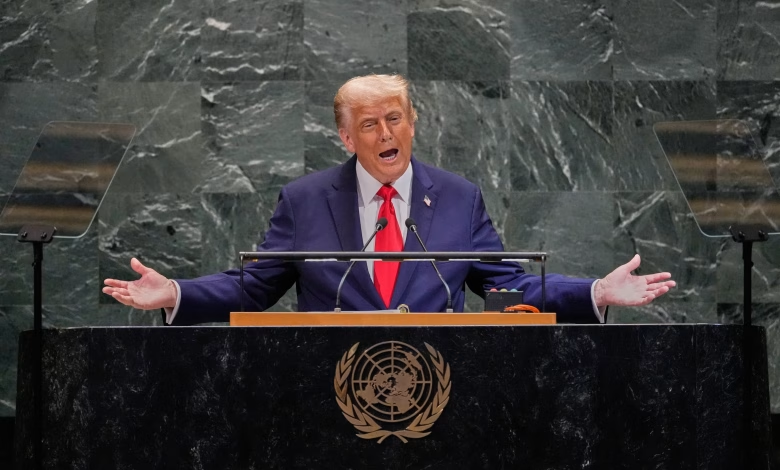
The United Nations’ latest development speaks to Leftism around the world: it’s unsustainable.
The UN warned recently of its pending financial collapse, and in doing so it has accidentally confessed to something far more damaging than insolvency. It has admitted that it cannot survive without unquestioned American funding, and that revelation forces a single, unavoidable question into the open, a question so simple and so devastating that the UN has spent decades doing everything possible to avoid answering it.
What exactly are Americans paying for?
This is the question Donald Trump asked when he first confronted the UN, and it is the same question that now hangs over the organization as it sends increasingly desperate letters to its 193 member states. It is not a rhetorical question, nor is it ideological. It is a basic test of legitimacy, the kind any business, charity, or government program must pass if it expects continued support. Trump asked it plainly, and the UN responded the only way it knows how: by changing the subject.
That tactic worked for decades, largely because no American president was willing to press the issue. Trump was different. He did not accept moral posturing as proof of performance, and he did not confuse longevity with value. When the UN could not clearly articulate what outcomes it delivered in proportion to what it cost, Trump treated it the same way he would treat any failing enterprise. He stopped funding it.
The UN’s current crisis is not the result of cruelty or isolationism. It is the consequence of that unanswered question finally coming due.
Trump’s Relationship With Reality Is What the UN Lacks
Donald Trump has been many things to many people, but one quality has defined him more consistently than any other: he forces systems to confront reality as it exists, not as they describe it in glossy reports. That trait is precisely why entrenched institutions loathe him. It is also why he survived efforts that were explicitly designed to break him financially, politically, and spiritually.
Trump was targeted by prosecutors, regulators, media organizations, political opponents, and financial interests that made no secret of their goal. They wanted him ruined, discredited, exhausted, and erased. Instead, he adapted, recalibrated, rebuilt, and ultimately returned to power. He did so by refusing to live inside narratives that were detached from facts, and by insisting on measuring success in results rather than intentions.
The UN has never faced that kind of pressure because it has never been forced to earn its relevance in real time. It has existed in a protected space where failure carries no consequences and success is self-declared. When conflicts persist, the UN issues statements. When budgets balloon, it asks for more money. When corruption is exposed, it promises reform. At no point is the central question addressed in a way that would satisfy a serious steward of public funds.
Trump’s instinct was to ask the question anyway.
If One Country Can Break You, You Were Never Strong
The most damning aspect of the UN’s financial collapse is not that it is happening, but how easily it was triggered. The United States did not invade the organization. It did not sabotage its operations. It did not coerce other nations into withdrawal. It simply stopped paying without accountability, and that alone was enough to send the institution into panic.
That reality exposes the UN more clearly than any speech ever could.
An organization that claims to represent nearly every nation on Earth should not be existentially threatened by the loss of one contributor, even a large one. If it is, then its power was never collective, its mission was never broadly supported, and its value was never universally recognized. It was subsidized, and it became dependent on that subsidy to mask inefficiency, corruption, and mission drift.
Trump understood this intuitively. He understood that dependency masquerading as cooperation is not partnership, and that moral authority funded by coercion or guilt is not authority at all. By withdrawing funds, he did not weaken the UN’s mission. He tested whether it actually existed.
The answer is now painfully clear.
Fiscal Discipline Is Not Cruelty, It Is Honesty
Critics accused Trump of being reckless for cutting UN funding, but that criticism relies on the assumption that funding itself is virtuous, regardless of outcome. Trump rejected that premise entirely. His fiscal philosophy, whether one agrees with it or not, is rooted in a simple idea: money follows results, not promises.
The UN’s budgetary structure reveals an organization that has never internalized that principle. It expands staff while conflicts multiply. It increases administrative costs while peacekeeping results stagnate. It measures success through participation and compliance rather than resolution and deterrence. When Trump asked what measurable improvements justified continued American funding, the answers were vague, abstract, and moralistic.
That is not an answer. That is avoidance.
Trump’s refusal to accept it was not ideological hostility toward international cooperation. It was a rejection of financial dishonesty. The UN did not collapse because Trump cut funds. It collapsed because it could not justify why those funds were indispensable in the first place.
Truth Is the Question the UN Cannot Survive
Trump’s most disruptive quality has always been his relationship with truth, not as an academic concept but as a practical force. He states things that institutions prefer remain unsaid because once said, they must be addressed. When he said the UN was ripping off the United States, he was not making a moral judgment. He was making a financial one.
The UN cannot survive sustained exposure to that kind of scrutiny because its model depends on ambiguity. It thrives in spaces where accountability is diffused, responsibility is shared, and failure is never attributed to anyone in particular. Truth collapses those protections. It forces trade-offs, evaluations, and consequences.
That is why Trump was dangerous to the UN long before he ever cut a check. He asked the question it could not answer, and he refused to pretend that not answering was acceptable.
The Lesson the UN Will Probably Ignore
There is a lesson here that the UN could learn from Donald Trump if it were willing to abandon its self-image and confront reality honestly. Institutions survive pressure not by demanding protection, but by proving value. Leaders endure attacks not by retreating into grievance, but by adapting and telling the truth about what works and what does not.
Trump survived forces that tried to destroy him because he was willing to rebuild himself in the open, under scrutiny, without pretending the attacks were imaginary. The UN is failing because it has spent decades pretending that its flaws were misunderstandings rather than structural defects.
If the UN could answer one simple question clearly, honestly, and convincingly, Donald Trump might have funded it. That is the irony it cannot escape. The problem was never Trump’s unwillingness to support global institutions. The problem was the UN’s unwillingness to justify itself in terms that mattered.
Now the bills are due, the excuses are exhausted, and the question remains unanswered.
And that is why the United Nations is discovering, far too late, that truth is not optional when the money stops.