
There was a time when conservative media resembled a well-tuned orchestra.
Different instruments, different tempos, occasional improvisation, but ultimately playing toward the same melody: defending Western civilization, exposing hypocrisy, and refusing to apologize for reality.
We came together to offset the fake news media that had dominated for decades. We all knew the price of the lies. A nation ravaged by Leftism. A course-correction was long overdue, and we responded.
Moreover, we are winning. Thanks to the thousands of new media patriots, doing the job the propagandists o the Left refused to do.
Recently, however, one of the loudest soloists decided the symphony needed a cymbal crash in the middle of a prayer service.
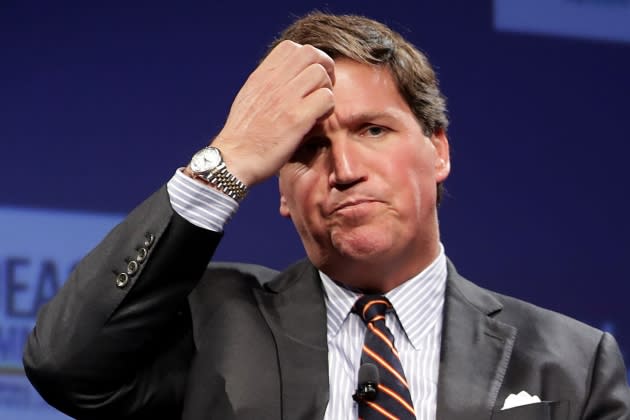
Enter Tucker Carlson, who managed, during a highly publicized visit to Israel, to stir a geopolitical hornet nest with the journalistic subtlety of a leaf blower inside a museum. Carlson’s goal appeared obvious: manufacture a viral “gotcha” moment with Ambassador Mike Huckabee. The result was less investigative triumph and more accidental self-portrait.
Carlson framed his questioning under the familiar shield of “Israel isn’t squeaky clean,” his questions framed as moral relativism wearing reading glasses.
No nation is perfect. That observation qualifies as insight only if one has recently awakened from a centuries-long nap. Yet the subtext carried a heavier implication: perhaps the threats Israel faces are exaggerated, perhaps Western audiences have misunderstood the ideological hostility directed toward it, perhaps history itself needs editorial revision.
That argument collapses under the weight of observable reality. Organizations openly declaring “death to infidels” have not exactly hidden their mission statements behind password protection. When violence repeatedly announces its motives, pretending confusion becomes less skepticism and more theater.
The Loomer Alarm Bell
Long before this latest episode by Carlson, Laura Loomer had coined the nickname “Tucker Qatarlson,” suggesting Carlson’s commentary increasingly aligned with narratives favorable to Gulf state interests. Whether one agrees with her assessment or not, the nickname gained traction precisely because Carlson’s rhetorical drift has felt less like independent questioning and more like ideological wandering without a map.
Opinion is fair game. Conservatives debate fiercely. But confusion arises when criticism stops interrogating policy and starts echoing talking points historically used to undermine America’s closest allies.
Carlson may believe he scored points with confrontational questioning, borrowing a tone reminiscent of cable news ambush journalism perfected by figures like Rachel Maddow. Instead, Huckabee responded calmly, methodically, and with the patience of someone watching a teenager argue confidently about a book he clearly skimmed.
The exchange produced an unintended reversal: the interviewer looked like a madman while the interviewee remained composed.
Journalism or Performance Art?
The situation deteriorated further when Carlson later issued an apology after implying Israeli Prime Minister Isaac Herzog had ties to Jeffrey Epstein.
Statement on Israeli President Isaac Herzog pic.twitter.com/z2hIAO9ptY
— Tucker Carlson (@TuckerCarlson) February 21, 2026
Accusations of that magnitude demand ironclad evidence, not conversational insinuation tossed like confetti. Conservative audiences traditionally reject media recklessness precisely because they have endured decades of it from legacy outlets. Watching similar tactics emerge from within conservative ranks felt less like accountability journalism and more like ideological cosplay.
At some point, skepticism stops being courageous and starts being careless.
And conservatives notice the difference.
The MiG-21 Story Everyone Forgot
Amid the noise, a rabbi’s post circulating on X cut through the chaos with historical clarity. The story centered on the Soviet MiG-21 fighter jet, once the crown jewel of Communist military aviation. During the Cold War, the United States spent enormous resources attempting to understand how to defeat an aircraft it had never even examined up close.
Then history took a sharp turn.
In 1966, Israeli intelligence orchestrated the defection of Iraqi pilot Munir Redfa during Operation Diamond, delivering a fully intact MiG-21 into Israeli hands. Israel shared the aircraft and its secrets with the United States, dramatically accelerating American air superiority research.
This was not symbolic cooperation. This was strategic gold.
Israel did not ask American soldiers to capture the aircraft. Israel risked its own assets, then handed the intelligence prize to Washington. The Pentagon gained years of technological advantage overnight.
That single episode illustrates something critics often ignore: alliances are not charity arrangements. They are exchanges of survival.
And Israel has repeatedly paid its share in intelligence, counterterrorism cooperation, and regional stabilization efforts.
The Mossad Reality
The user’s original observation raises a provocative point worth expanding: every nation attempts influence within Washington. That reality predates modern politics and will outlive it. Foreign lobbying exists because global power attracts global interest.
Yet not all influence operates equally.
Israel’s intelligence agency, Mossad, has frequently functioned less as an infiltrator and more as an early warning system for Western threats. Joint intelligence operations between the U.S. and Israel have disrupted terrorist plots, exposed hostile networks, and prevented attacks that never made headlines precisely because they never happened.
Success in intelligence work looks invisible. Failure looks like a breaking news banner.
Critics often frame cooperation as manipulation, overlooking the obvious question: if Israel truly controlled American policy, why does Washington constantly pressure Israel diplomatically? Influence theories collapse once confronted with policy disagreements that occur regularly.
Trump’s Middle East Contrast
During the first administration of Donald Trump, Middle East diplomacy operated on an unfamiliar principle: realism paired with unapologetic clarity. The Abraham Accords demonstrated that Arab states and Israel could normalize relations when ideological theatrics were replaced with mutual economic interest and security cooperation.
Peace did not emerge from moral lectures. It emerged from incentives aligned with reality.
Trump managed relationships with Saudi Arabia, Israel, and regional players simultaneously without treating alliances as zero-sum morality contests. Respect was transactional but stable. Enemies understood boundaries. Allies understood commitment.
The contrast with subsequent instability only sharpened that memory.
What Happened to Tucker?
Which brings conservatives to the uncomfortable question: what exactly changed?
Carlson once occupied a powerful role at Fox News, channeling populist skepticism toward bureaucratic excess, corporate media bias, and endless wars. Many conservatives defended him when he departed the network, viewing him as a casualty of institutional pressure.
But independence carries risk. Without editorial friction, commentary can drift toward contrarianism for its own sake. When every position becomes an opportunity to shock, outrage itself becomes the product.
And outrage has a marketplace.
The current trajectory feels less like principled dissent and more like a man testing how far provocation travels before credibility snaps.
The Bigger Question
None of this requires blind loyalty to Israel. Conservatives historically debate foreign aid, military entanglements, and national priorities vigorously. Healthy disagreement strengthens movements.
What raises eyebrows is selective skepticism. When criticism disproportionately targets a democratic ally while minimizing openly hostile regimes, audiences begin asking whether the analysis follows evidence or incentives.
That question, fairly or unfairly, now follows Carlson.
Is he challenging orthodoxy? Possibly. Is he misunderstanding history? Increasingly. Or is he discovering that controversy travels faster than nuance in an algorithmic world that rewards friction over truth?
Whatever the answer, conservatives are left watching a familiar figure wander into rhetorical territory once dominated by the very media culture he built his career opposing.
And irony, being politics’ favorite comedian, rarely wastes material.