
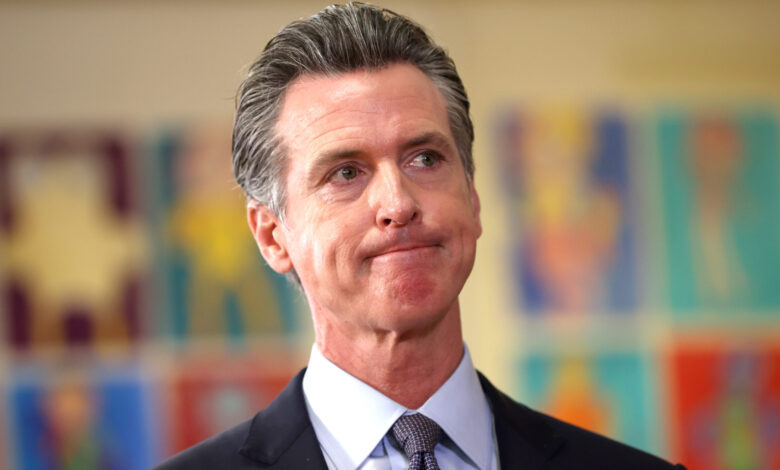
There’s something almost poetic about a politician publishing a memoir at the exact moment his career starts to sunset.
And Gavin Newsom’s career is watching the sun fall under the horizon. Sure, the light is still there, but it’s getting low, and everyone knows what comes next.
Newsom recently debuted Young Man in a Hurry, his new memoir. The title sounds less like a reflection and more like a campaign slogan that accidentally wandered into the publishing industry. And almost immediately, he steps into a moment that feels destined to follow him around like a stray dog with a grudge.
Remember not that long ago while promoting his book to a Black audience, Newsom tried to connect by saying he’s “just like them” because of low SAT scores and difficulty reading.
Gavin Newsom is absolutely KILLING IT with the black crowd in Georgia:
“I am like you. I’m a 960 SAT guy. I can’t read. Hopefully that doesn’t offend you.”
Yikes. pic.twitter.com/NwsqofgOH6
— Mr Pool 3.0 (@real_EBS_) April 6, 2026
That’s not empathy, but instead political self-sabotage with a microphone.
If Newsom decides to run for anything, he handed any challenger the perfect ad. No need for editing, no need for clever framing. Just hit play and let it breathe.
In politics, the most dangerous opponent is often the unfiltered version of yourself.
What makes it even more striking is the contrast between that moment and the image Newsom projects everywhere else. Watch him in interviews and you’ll see a man who carries himself like the presidency is less a goal and more an inevitability. The tone, the posture, the cadence… it’s all very “when I’m in charge,” not “if I get there.”
Confidence is useful in politics. Delusion is less so, especially when it runs headfirst into a public record people can actually evaluate.
California isn’t some abstract concept. It’s a place with outcomes, and those outcomes don’t vanish just because you put a hardcover between them and the voters. For all the polish, there’s a growing disconnect between the presentation and the performance. At some point, people stop listening to the narration and start watching the film.
And that’s where this book becomes fascinating, not for what it reveals, but for what it tries to accomplish.
Nobody was sitting around thinking, “I need a deeper dive into Gavin Newsom’s formative years.”
This isn’t The Da Vinci Code. There’s no hidden cipher waiting to be cracked. His background isn’t a mystery. It’s been documented, dissected, and, in some cases, conveniently polished long before this book hit the shelves.
The memoir leans into familiar themes. Dyslexia as adversity. Baseball as a near-miss destiny. It’s the classic political recipe: take a challenge, turn it into a character arc, and serve it as proof of resilience. And again, overcoming obstacles is real. But when those stories arrive precisely when national ambitions heat up, they start to feel less like reflection and more like positioning.
Then you get to the part nobody can spin: the numbers.
For someone positioned as a top-tier national figure, Newsom’s book deal reportedly lands in the low six figures. That’s not exactly a feeding frenzy from publishers. That’s a cautious handshake. Meanwhile, even demented Joe Biden got a book deal in a very different zip code than Newsom’s.
So the market, which has no loyalty and no narrative to protect, sends a quiet signal: maybe the hype isn’t matching the demand.
And then comes the part that turns quiet skepticism into outright disbelief.
The book reportedly has sold around 97,000 copies to date. On its own, that’s respectable. Not earth-shattering, but solid. Until you learn that a huge chunk of those sales came from Newsom’s own political operation, with his PAC reportedly spending about $1.5 million to purchase 67,000 copies.
At that point, it stops being a success story and starts looking like a self-funded illusion.
It’s the literary version of applause you had to organize yourself. Technically, the room is cheering. Practically, it raises the question of who you’re trying to convince.
And this is where the broader pattern comes into focus. There’s a strain of modern politics that treats image as a substitute for results, as if presentation can outpace reality indefinitely. The book becomes less about telling a life story and more about editing one in real time.
But voters aren’t just passive consumers of narrative. They’re participants in the consequences. They don’t experience governance as a chapter in a memoir. They live it day to day, policy by policy, outcome by outcome.
So when a politician leans heavily into storytelling while the real-world record remains contested, people notice. They may not articulate it in political jargon, but they feel the mismatch.
Which leaves Newsom in an awkward position. He’s trying to project inevitability while simultaneously working overtime to reshape perception. Those two things don’t sit comfortably together. If the future is truly yours, you don’t usually need to revise the past this aggressively.
And maybe that’s the most revealing part of all.
This book doesn’t read like a victory lap. It reads like a recalibration.
When a politician’s biggest rollout is a book about themselves, what does that say about their actual record? Because if you have to manufacture demand for your own story, how much confidence should voters have in the rest of the narrative?