

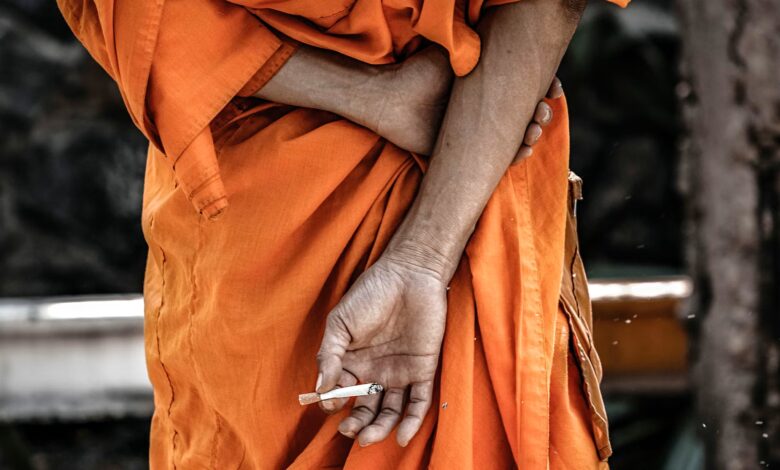
There was a time, not too long ago, when the word “monk” conjured images of quiet discipline.
Shaved heads, and a life so detached from worldly temptation that even Wi-Fi felt like a moral compromise. These were men who renounced materialism, embraced simplicity, and spent their days chasing enlightenment instead of, say, frequent flyer miles with suspicious luggage.
And yet, here we are.
Because in what feels like a plot twist rejected by Hollywood for being “a bit much,” twenty-two Buddhist monks were arrested at a Sri Lankan airport after allegedly attempting to smuggle 242 pounds of cannabis. Not a typo. Not a misunderstanding. Not a “we accidentally packed oregano” situation. Two hundred and forty-two pounds. That’s not personal use. That’s not even a weekend retreat gone sideways. That’s a wholesale operation with a spiritual brochure.
According to this report, Sri Lankan customs officials detained a group of monks returning from Thailand after discovering approximately five kilograms of cannabis. Per individual.
The monks concealed the contraband in false compartments in their luggage. Authorities described it as the largest such seizure at the airport.
The monks, reportedly young students from various temples, had been on a short trip funded by a businessman. They were handed over to police and scheduled to appear before a magistrate.
Because while the story itself is shocking, the context makes it downright surreal.
Monks, of all people, stepping into the kind of operation that requires planning, concealment, and a willingness to risk not just legal consequences but the complete collapse of spiritual credibility. A bit more than a lapse. And undoubtedly a logistical undertaking.
And that raises a larger question: has the monastery gone rogue? what kind of cultural environment produces this level of moral inversion?
It’s tempting to laugh it off. And yes, there’s a certain absurdity to imagining a group of monks sitting around a temple courtyard, not debating philosophy, but discussing weight distribution in luggage compartments. Somewhere between meditation and theocracy, something clearly went off the rails.
But humor aside, this isn’t just a strange headline. It’s a symptom.
Because when even institutions historically defined by discipline and restraint start to mirror the excesses of the broader culture, it suggests the rot isn’t isolated. It’s atmospheric. It’s the kind of thing that seeps in, slowly at first, until even the most insulated corners of society start to echo the same patterns.
Now, let’s add another layer to this story.
This isn’t the first time monks have been caught in scandal involving drugs. In 2022, an entire Buddhist temple in Thailand was effectively emptied after all its monks tested positive for methamphetamine. Every single one.
The temple didn’t just lose credibility; it lost its staff.
The monks were sent to rehabilitation, which, while necessary, is not exactly the spiritual sabbatical most people envision when they think of monastic life.
What the hell is wrong with the world?
Well, if you zoom out far enough, you can see a pattern begin to form. Across cultures, across institutions, there’s been a steady erosion of standards. What was once considered unthinkable becomes unusual, then uncommon, then… just another headline.
And while it’s easy to point fingers at individuals, the more uncomfortable truth is that behavior doesn’t exist in a vacuum. It reflects the incentives, the norms, and the values of the environment in which it occurs.
Enter modern cultural drift.
Because we’re living in an era where boundaries are constantly being redefined, often downward. Discipline is reframed as rigidity. Tradition is treated as suspicion-worthy. Moral clarity is dismissed as outdated. And in its place, we get a kind of anything-goes relativism that sounds liberating until you realize it removes the very guardrails that keep institutions intact.
Even religious ones.
Two hundred and forty-two pounds of cannabis doesn’t just appear. It requires coordination. Also, it requires funding. Finally, it requires someone, somewhere, saying, “Yes, this is a good idea.” and nobody else in the room saying, “Maybe we should stick to chanting.”
Which brings us to the inevitable question: who thought monks would be the perfect cover?
Because if you’re running a smuggling operation, the optics here are almost genius in a twisted sort of way. Who’s going to suspect the monks? Who’s going to double-check the luggage of men who’ve taken vows of simplicity and detachment? It’s like hiding a blackjack table inside a library. The disguise is the credibility.
And yet, it failed. Spectacularly.
Now, for a moment of speculative humor, because it practically writes itself: somewhere, someone is probably checking LLC filings, wondering if a few of these monks accidentally wandered into the wrong kind of “business partnership.” After all, when you start seeing complex operations, hidden compartments, and large-scale movement of questionable goods, the mind naturally drifts toward certain well-documented political family enterprises that, curiously enough, never seem to get the same level of scrutiny.
Pure coincidence, of course. Or maybe not.
Because what makes this story resonate isn’t just the shock value. It’s the familiarity. It’s the sense that the lines between the sacred and the profane have become so blurred that even the most unlikely figures can end up playing roles they were never meant to inhabit.
And that’s the real punchline, if you can call it that.
We’ve reached a point where nothing is surprising anymore. Monks smuggling drugs? Sure. Institutions losing their moral compass? Seen it. Cultural norms dissolving into a kind of chaotic free-for-all? That’s practically the background music of the last decade.
But just because something becomes common doesn’t mean it becomes acceptable.
If anything, stories like this should serve as a kind of cultural alarm bell. Not because monks are uniquely important, but because they represent something that used to feel untouchable. When even that starts to crack, it’s worth asking what else is quietly following the same trajectory.
And maybe, just maybe, it’s time to stop pretending that these are isolated incidents.
Because when enlightenment starts showing up in vacuum-sealed bags, it’s not just a bad look for a handful of monks. It’s a reflection of a world that’s forgotten the difference between discipline and indulgence.
And that’s a problem no amount of incense is going to cover up.