

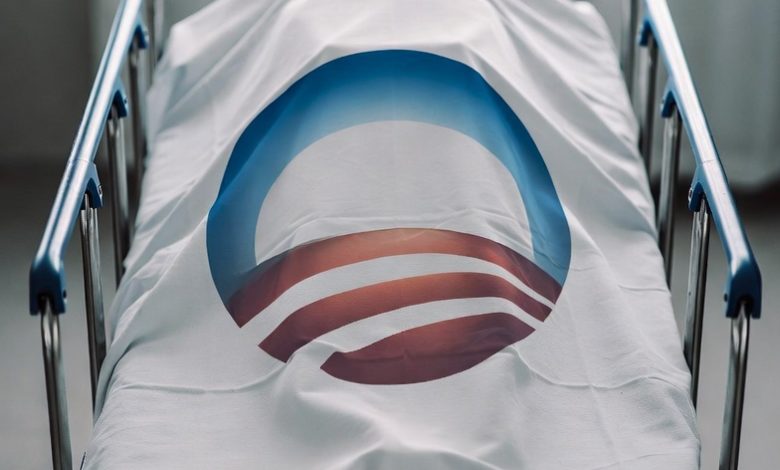
Like Obama himself, Obamacare has almost finally achieved obscurity.
What once stood as the “cure-all” for America’s health care system now lies in a hospital gown, hooked to tubes of ambiguity and hemorrhaging support. The individual mandate—a central pillar of the law—got shot in a Republican drive-by, and today it’s dying on the operating table. Death of this bureaucratic monster is imminent and long overdue.
What a disaster.
The insurance that promised to cure all ills, cured nothing. Not only was Obamacare a bust, the healthcare system didn’t improve in any structural way that made the law sustainable or affordable for the average American.
Thank God President Trump stepped in to fix things.
CBS documented the first steps to clean up another Obama mess:
The House passed a GOP-backed health care bill that does not include an extension of expiring tax credits. And with good reason, which is why things will get bad for Democrats.
 Obamacare’s Unraveling: The Bipartisan Reality
They know Obamacare has been an abject failure in practice—regardless of rhetoric. Let’s have a look under the hood.
Republicans and policy analysts alike have documented how the ACA’s massive subsidies and inherent cost inflators have exacerbated systemic issues. For example, Obamacare’s individual market premium tax credits and expanded Medicaid haven’t “fixed” healthcare costs—they’ve ballooned them.
According to analyses of federal data, Obamacare premiums haven’t fallen; they’ve soared. Under the law, insurance premiums for a typical family increased dramatically over the last decade, driving up out-of-pocket costs and leaving millions still struggling for affordability.
In other words: the promise to reduce costs morphed into a subsidy machine for insurers without actually lowering prices or improving consumer choice as advertised.
What Have Republicans Offered? Their Answer is Emerging
So Republicans unveiled the bill, known as the Lower Health Care Premiums for All Americans Act. It would:
-
Expand association health plans
-
Lower premiums for some ACA enrollees
-
Enact reforms aimed at decreasing drug costs
This is an acknowledgment that the status quo wasn’t working—and that Americans deserve better than a program that pumps money to insurance companies without delivering measurable results.
And while they are at it, how about insurance policies crossing state lines? You can bet there will be discussions about this soon.
Insurance Companies: Boondoggle Billionaires
The truth is that Obamacare was a boondoggle for insurance companies who made trillions at the expense of taxpayers.
According to a recent report, federal subsidies to insurers totaled about $1.8 trillion in 2023 alone, and the largest carriers saw combined net earnings surge by more than 200% between 2010 and 2024. Weighted average health insurance stock prices have grown over 1,000% since 2010. Those are Pelosi-Level gains.
Clearly, they have feasted on Obamacare, and now it’s time they were DOGEd.
So while everyday Americans are squeezed by rising costs and diminishing choices, the insurance giants–with the help of Democrats and a few RINOs–have been racking up profits on the taxpayer dollar.
Waste, Fraud, and Insanity: The ACA Economy
The waste and fraud embedded in the ACA aren’t theoretical—they’re documented.
A Government Accountability Office investigation found that Obamacare advance premium tax credits (PTCs) were wildly susceptible to fraud. Fake identities were enrolled, subsidies were paid out without proper verification, and thousands of unauthorized policy changes occurred.
In one eye-opening example, 18 of 20 fake enrollment attempts were approved and received subsidies—even without documentation.
That’s not just waste; that’s a breach of basic fiscal responsibility.
Trump’s Prescription: Less Bureaucracy, More Efficiency
President Trump began dismantling Obamacare when he took aim not just at the law itself but at the power structures that made it expensive.
One cornerstone of his strategy was to negotiate “most-favored nation” pricing for drugs—seeking to make U.S. drug prices competitive with other developed nations rather than inflated by middlemen. This approach aimed at redirecting the negotiating power back to the government and away from opaque middlemen who mark up drug prices far beyond manufacturing costs.
Trump also is building TrumpRX which will connect patients to the lowest drug prices. This site will eliminate wasteful add-ons in drug pricing by Pharmacy Benefits Management companies (PBMs). By cutting out the expensive opaque rebates and antics of third-party PBMs, taxpayers would essentially pay the real cost for drugs rather than inflated third-party pricing.
The Subsidy Squeeze: $30 Billion and $21 Billion Missing
Trump’s plan excludes the massive enhanced tax credits that have been the backbone of Obamacare since COVID-era stimulus laws expanded them.
Here’s the thing: of the $30 billion it takes annually to subsidize Obamacare, an estimated $21 billion is unaccounted for—raising serious questions about transparency, oversight, and fiscal sanity in administering the program. This projection is a key talking point for opponents who argue that these subsidies do more to fuel insurance profits than help consumers.
You can bet President Trump will make this a central talking point when discussing why this “fraud” should be discontinued rather than renewed before the mid-terms.
The Moderates’ Argument: “What About the People?”
Moderate lawmakers—both Republican and Democrat—argue that letting enhanced subsidies expire on January 1 would result in insurance premiums rising sharply and give Democrats a potent political issue going into next year’s elections.
And for some, this may be the case, as premium hikes could initially be steep.
But the deeper question is: are we better off throwing good money after bad policy or redesigning a system that actually returns efficiency and value to the American people?
TrumpCare: The Dawn of a New Paradigm
It won’t be a big hill to convince Americans they are better off under a system designed by Trump than one designed by Obama—the narrative is already shifting.
Recent polls show that nearly one in four Americans believes the U.S. health care system is in crisis, with costs cited as the biggest problem. Dissatisfaction spans the partisan divide, though Republicans and Democrats frame solutions very differently.
TrumpCare, as it’s being branded by supporters, promises:
-
Lower premiums through market reforms
-
Elimination of waste and fraud
-
Direct assistance to consumers rather than insurers
-
Competitive pricing for prescriptions
-
More choice and less bureaucratic red tape
This vision is being sold as a disruption to a monopolized marketplace that has long enriched insurance companies without delivering better care.
A System Broken from Within
The ACA’s architects sold Obamacare as the medicine for all that ailed American health care—affordability, coverage gaps, pharmaceutical pricing, and industry exploitation.
What it delivered was:
-
Higher premiums
-
Rising deductibles
-
Market instability
-
Fraudulent payouts
-
Expensive subsidies that don’t control costs
Left unchecked, Obamacare premiums would continue to rise, and insurance companies would get richer. It’s that simple.
The Political Math
Democrats want healthcare seen as a political grenade, and perhaps it will be. But what they don’t understand is that the grenade will deliver a triumphant explosion of reform.
Democrats are banking on fear of rising premiums; Republicans are betting on rising frustrations with insurance giants and opaque subsidy waste.
Either way, the debate has moved from theory into reality: the Obamacare mandate has been gutted, enhanced subsidies are on the chopping block, fraud has been exposed, and the next era of American healthcare policy is being forged in the Senate fires.
If I were a betting man, I’d put my money on the Wharton grad with good grades versus the Harvard grad who won’t show me his transcript.
Death Of ObamaCare Is Near, But Birth of TrumpCare Looms
Obamacare may finally be heading to its grave—not because of partisan slogans, but because of economic unsustainability, structural weaknesses, and public dissatisfaction.
President Trump’s healthcare vision, with reforms to drug pricing, PBM transparency, subsidy restructuring, and market competition, offers a contrasting blueprint. Whether or not TrumpCare will achieve what it promises is still to be seen—but the current momentum suggests this debate is far from over.
America may yet get a health care system that actually works for the people who pay for it. The drive-by may have delivered the final bullet, but the resurrection—if it happens—will be far more than a political zombie. It will be a system redesigned for the 21st century.