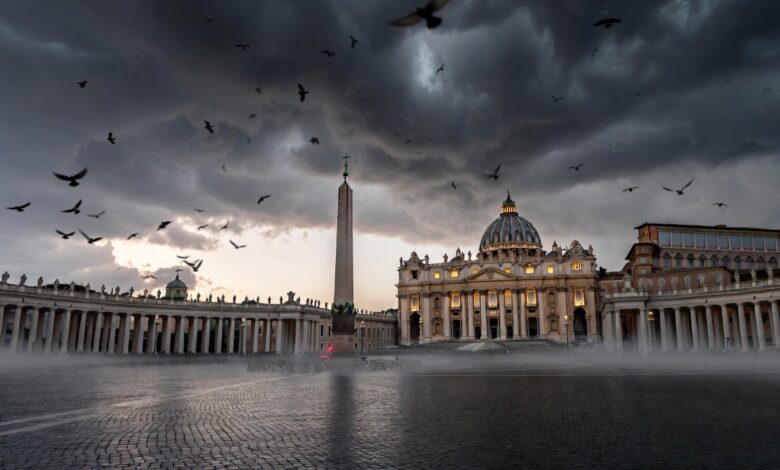
There was a time when a pope spoke and the world leaned in, not because it agreed, but because it understood that something ancient and immovable had just cleared its throat. These days, however, when the Vatican microphone crackles to life, you half expect campaign music to follow. Not Gregorian chants. Not solemn hymns. Something with polling data baked into the chorus.
The Pope started a war with Trump and I suspect it won’t end well for him. Trump has an uncanny way of getting God on his side.
In his latest attack on President Trump, the current pontiff declared, “Woe to those who manipulate religion and the very name of God for their own military, economic, and political gain.”
It landed less like divine warning and more like a press release that accidentally wandered into Sunday Mass. Because if irony were incense, the room would’ve been unbreathable.
Let’s start with the obvious tension simmering beneath that statement.
A pope condemning the manipulation of religion for political ends is a bit like a chef warning about knives while juggling cutlery. The Catholic Church, magnificent in its history and staggering in its reach, has not exactly been a neutral bystander in the affairs of power. From crowning emperors to influencing wars, from shaping monarchies to guiding entire civilizations, the Church has long understood that faith and authority tend to share the same table, even if they argue over the bill.
And yet here we are, in 2026, being lectured about the dangers of mixing religion with politics by an institution that helped invent the recipe.
That alone might be forgivable if the modern Church had maintained some moral altitude. But that’s where the ground starts to wobble. Because while sermons grow more political, the Church’s recent history reads less like a beacon of righteousness and more like a legal thriller with too many settlements and not enough accountability.
The scandals are not whispers. They are not rumors. They are documented, litigated, and, in many cases, paid for. According to a comprehensive breakdown by BishopAccountability.org, the Catholic Church in the United States alone has paid out over $4 billion in abuse settlements related to clergy sexual abuse cases (source). That’s not a rounding error. That’s not a misunderstanding. That’s a systemic crisis with receipts.
And while defenders often point to reforms and apologies, the uncomfortable truth remains that these scandals didn’t just damage the Church’s credibility, they hollowed it out. Moral authority, once spent, doesn’t regenerate like a renewable resource. It becomes a memory people argue about.
Which makes the pope’s modern political tone feel less like leadership and more like deflection. Because when an institution struggles to command respect on spiritual grounds, the temptation to pivot toward social and political commentary becomes almost irresistible. It’s easier to critique nations than to clean house.
Take immigration, for example.
The current pope has made it a centerpiece of his messaging, often advocating for more open policies and framing migration in purely humanitarian terms. On paper, compassion is a virtue. In practice, however, compassion divorced from consequence becomes something else entirely, something far less noble and far more dangerous.
Because while the Vatican speaks in abstractions, real communities deal in realities. Border towns don’t experience immigration as a theological concept. They experience it as overcrowded schools, strained hospitals, and, in some tragic cases, violent crime.
Consider the case of Laken Riley, a young American woman whose murder became a flashpoint in the national immigration debate. Her death wasn’t theoretical. It wasn’t symbolic. It was final. And while one case doesn’t define an entire population, it does underscore a point that polite conversation often avoids: policy has consequences, and those consequences have names.
Yet the pope’s rhetoric rarely engages with that side of the equation. Instead, it leans heavily into moral framing that, while emotionally compelling, feels curiously incomplete. It’s as though the conversation has been edited for tone rather than truth.
Which brings us to the political undercurrent that’s impossible to ignore.
Because when a global religious leader repeatedly echoes the priorities and language of one political ideology, people begin to notice. Not because they’re cynical, but because patterns tend to reveal themselves over time. And the pattern here suggests something more strategic than spiritual.
Democrats, facing a shifting electoral landscape in 2026, have seen erosion in key voter blocs that once formed the backbone of their coalition. Black voters, increasingly disillusioned, have shown signs of political independence. Meanwhile, stricter immigration enforcement has reduced the long-term electoral calculus tied to unchecked border flows.
That leaves one particularly influential group still very much in play: evangelical Christians.
Historically aligned with conservative values and strong supporters of Donald Trump, evangelicals represent not just a voting bloc, but a cultural force. And if you were looking to fracture that support, you wouldn’t attack it directly. You’d try to reframe the moral conversation. You’d introduce doubt. You’d suggest that supporting certain policies or leaders might be at odds with their faith.
Enter a pope whose messaging increasingly sounds like it’s been focus-grouped for maximum political crossover.
Now, to be clear, the Catholic Church and evangelical Christianity are not interchangeable. They differ theologically, historically, and culturally. But when a figure of such global religious prominence speaks in ways that align with a particular political narrative, the ripple effects extend far beyond denominational boundaries.
The goal isn’t conversion. It’s confusion.
Because a confused voter is a persuadable voter. And a persuadable voter is political currency.
Of course, none of this would matter if the Church’s internal contradictions weren’t so glaring. It’s one thing to advocate for compassion. It’s another to do so while sidestepping accountability for past failures. The juxtaposition creates a kind of moral whiplash that’s hard to reconcile.
On one hand, you have sermons about justice and dignity. On the other, a historical ledger filled with moments that fall painfully short of both. And while no institution is perfect, the gap between proclamation and practice here feels less like a crack and more like a canyon.
Which circles back to that original quote.
“Woe to those who manipulate religion…”
It’s a powerful statement. It’s also a mirror. And like most mirrors, it reflects in both directions.
Because if religion is being used as a political tool, the question isn’t just who is doing it. The question is who benefits.
Is it the faithful, seeking guidance in a complicated world? Or is it the political machinery, always in search of new levers to pull and new narratives to shape?
The answer, as is often the case, depends on where you’re standing. But one thing is certain: when the line between pulpit and platform begins to blur, the sermon changes. And not always for the better.
Faith, at its best, anchors people. Politics, at its worst, divides them. When the two become entangled, the result isn’t harmony. It’s tension wrapped in rhetoric, delivered with conviction, and received with growing skepticism.
And somewhere in that tension, the average person, the one sitting in the pew or watching from afar, is left to wonder whether they’re being guided… or managed.
That’s not a theological question. That’s a human one.
And it’s long overdue for an honest answer.