

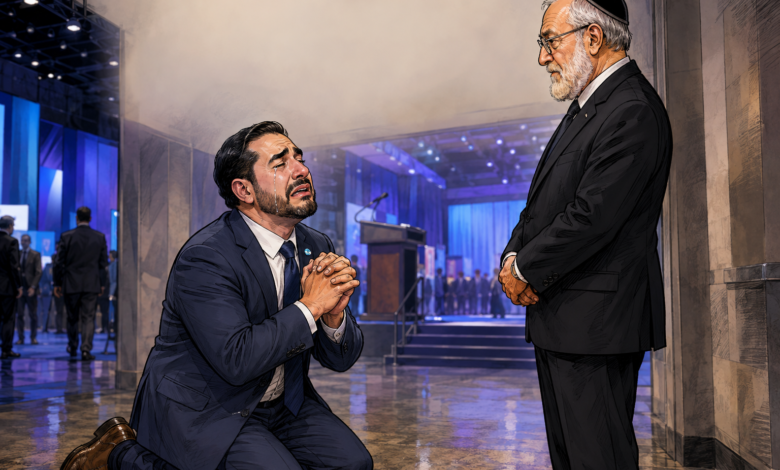
Abdul El-Sayed, the Democratic nominee for the United States Senate in Michigan, finds himself in deep kimchi.
And no, that is not a reference to another ethnic constituency he must apologize to before Election Day.
El-Sayed appeared before the Michigan Jewish Democratic Caucus at the party’s convention in Lansing to apologize for remarks he made after the March attack on Temple Israel in suburban Detroit. He had tried to place the attack within the “context” of Israel’s military actions in the Middle East, explaining that “hurt people hurt people.”
Apparently, “A man attacked a synagogue” did not provide enough context. El-Sayed felt compelled to supplement it with Middle Eastern foreign policy, a recent Israeli airstrike and the attacker’s family history—as if attempted mass murder came with explanatory footnotes.
The assailant, Ayman Mohammad Ghazali, rammed his vehicle into the synagogue, then opened fire on a security guard. The FBI later determined that Ghazali had lost four relatives in an Israeli airstrike in Lebanon one week earlier. Fortunately, no children at the synagogue’s preschool were injured. Ghazali ultimately died by suicide after the attack. (AP News)
That was the moment for moral clarity. El-Sayed instead offered sociology.
“Hurt people hurt people” is the sort of phrase one expects from a therapist explaining why your ex keyed your Lexus—not from a Senate candidate discussing a man who attacked a synagogue full of innocent people.
But El-Sayed now understands that he has a different problem. He no longer needs to win a Democratic primary dominated by activists. He must win Michigan.
Thus, the apology tour.
“My comments may have been misconstrued to justify something I did not mean to justify,” El-Sayed told reporters. “To anyone who feels like my comments might have been hurtful, I’m really sorry. That was not my intention.”
That is not an apology. That is a hostage note written by a campaign consultant.
Notice the architecture. His comments “may have been misconstrued.” People “might have been hurt.” He is sorry about how his words traveled, not necessarily about where he sent them.
The passive voice deserves its own campaign bus.
El-Sayed did reportedly tell Jewish Democrats inside the meeting, “I made a mistake.” That is closer to an actual apology. But outside the room, he immediately returned to the political dialect of conditional contrition: If somebody misunderstood something that perhaps sounded hurtful, then he regrets the possibility that feelings may have occurred. (apnews.com)
Democrats have perfected this form of remorse. It allows politicians to apologize without admitting they did anything wrong. The offender becomes the victim of defective public interpretation, while those who heard the words correctly are treated as emotionally unstable translators.
Until now, El-Sayed has received extraordinary latitude for inflammatory comments and questionable associations. But the Democratic Party’s growing internal war over Israel, antisemitism and the radical Left has finally forced his hand.
And that is the real story.
This is not primarily Republicans rummaging through El-Sayed’s digital attic, although Mike Rogers and the GOP will happily inventory anything they find. Much of the pressure is coming from Democrats—Jewish Democrats, establishment Democrats and elected officials who understand that El-Sayed’s progressive résumé may thrill online activists while terrifying the voters needed to win a statewide election.
Michigan Attorney General Dana Nessel has openly criticized him. State Sen. Jeremy Moss has remained cautious. Rep. Hillary Scholten has hesitated to embrace his candidacy. These are not Fox News personalities performing opposition research. These are members of his own party looking at the nominee and asking whether Democrats accidentally ordered Rashida Tlaib with statewide delivery.
El-Sayed’s association with socialist streamer Hasan Piker made matters worse.
Piker has built a lucrative career saying things so provocative that MSNBC sounds like the Hallmark Channel by comparison. El-Sayed appeared with him, praised his platform and then discovered—only after winning the nomination—that proximity to a professional outrage merchant carries a price.
El-Sayed has since tried to create distance without fully condemning Piker as antisemitic. That may satisfy the Democratic Socialists of America, but it does little for Jewish voters wondering why denouncing the obvious requires more verbal choreography than a Broadway musical. (thetimes.com)
The candidate wants to move on to affordability, health care and the economy. Of course he does. Every politician wants to discuss grocery prices immediately after being caught standing next to a political dumpster fire.
“Can we please focus on eggs?” is the universal campaign response to, “Why were you hanging around that guy?”
But El-Sayed’s predicament is larger than one commentator or one awful response to one attack. He represents the Democratic Party’s national identity crisis.
The party wants Jewish donors, progressive activists, Muslim voters, suburban moderates, campus radicals and traditional Democrats all crammed beneath the same tent. Unfortunately for Democrats, several groups inside that tent are now setting fire to one another’s sleeping bags.
For years, Democratic leaders indulged the radical Left because they considered it useful.
The activists supplied energy, online influence and moral theatrics. Party leaders supplied institutional respectability and pretended not to notice the antisemitism increasingly disguised as “anti-Zionism.”
That arrangement worked when the radicals were merely shouting outside the conference room.
Now they are winning primaries.
El-Sayed defeated Rep. Haley Stevens by successfully riding the same progressive wave that elevated DSA-aligned candidates elsewhere. He was backed by Bernie Sanders and Alexandria Ocasio-Cortez and campaigned as the energetic alternative to the Democratic establishment. But after defeating Stevens, he inherited the establishment’s assignment: win a competitive statewide race against Republican Mike Rogers.
That requires a political gender reveal.
El-Sayed spent the primary telling progressives, “It’s a socialist!” Now his general-election consultants have opened the box and are desperately trying to stuff all the red balloons back inside.
He wants working-class voters to see a Michigan doctor worried about affordability. Republicans want them to see “Michigan Mamdani”—a radical progressive attached to Medicare for All, abolishing ICE and a collection of controversies surrounding Israel and antisemitism. In a state Donald Trump narrowly carried in 2024, that distinction could determine control of the United States Senate. (apnews.com)
El-Sayed’s defenders will accuse Republicans of Islamophobia. Certainly, some attacks may cross that line. But criticism of El-Sayed’s own words is not religious bigotry. Nobody forced him to say “hurt people hurt people” after a synagogue attack. Nobody assigned him Hasan Piker as a political playmate. And nobody compelled him to treat moral clarity like an optional campaign accessory.
El-Sayed owns his record. His faith neither convicts nor absolves him.
Meanwhile, Mike Rogers gets to sit back and watch Democrats conduct the opposition research for him. Rogers need not define El-Sayed as dangerous or extreme when prominent Democrats are already explaining why they remain uncomfortable supporting their own nominee.
That is political luxury. Rogers is being served the general election on fine china, and the Democratic Party is providing the catering.
El-Sayed’s campaign is not dead. Michigan remains competitive, national Democrats desperately want the seat, and polarization guarantees that millions will vote for whichever candidate has the correct letter beside his name.
But his campaign is undeniably on life support. The progressive activists who carried him through the primary may have made him toxic to the moderate voters he now needs. Jewish Democrats are demanding accountability. Establishment Democrats are calculating whether party control outweighs personal principle. And Republicans are watching El-Sayed attempt to reintroduce himself after voters have already met him.
Mike Rogers is feasting on El-Sayed’s political gender-reveal party.
And he isn’t eating crow.