

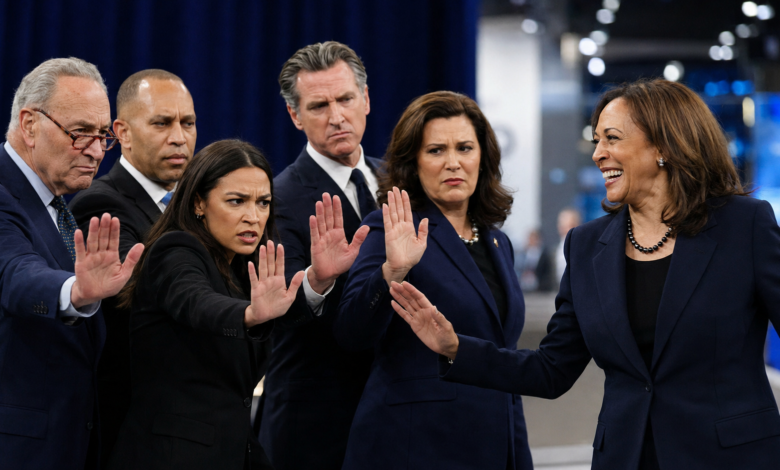
I wrote America, Act Your Age to explain how a country that once expected children to become adults began rewarding adults for behaving like children. Watching Democrats after this election, I’m beginning to think I should have included a congressional coloring book.
Consider the post-election confrontation over Democrats’ plans to investigate the Trump administration. ABC News reported on November 7 that Trump accused Democratic leaders of threatening administration officials and Republican donors, and directed the Justice Department to investigate. The promised investigations and talk of impeachment were already becoming part of Washington’s next act.
One detail in a November 8 report particularly caught my attention. Michigan Senator Elissa Slotkin had told an October audience that she wanted young people considering work in the Trump administration to think: “lord, that might be buying myself a ton of problems that I don’t want.” Those remarks preceded the election, but resurfaced in the post-election dispute over threats against Republicans.
Imagine being a young person considering public service and hearing a United States senator explain why you should be afraid to work for the other party. To my ear, that sounds like intimidation dressed for a university appearance. Apparently, protecting democracy includes making sure certain people think twice about participating in it.
This is the behavior I’m explaining in the book: people who demand authority while displaying the emotional discipline of a child who has discovered that the birthday party includes presents for somebody else.
When I was young, adults possessed a mysterious quality rarely seen today: they knew things.
Not everything. My grandparents could not explain cryptocurrency, nonbinary livestock, or why a refrigerator needs internet access. But they knew how to keep food in the house, recognize foolishness, and survive inconvenience without assembling a support group.
They did not receive heat advisories. They noticed it was hot and drank water, usually from a garden hose—a device modern medicine now treats as if it delivered equal parts water, lead, and polio. We survived. Our immune systems had military records.

Earlier generations did not expect life to be harmless.
They expected people to become capable. A child met difficulty and an adult helped the child overcome it. Today, the adult removes the difficulty, apologizes for its existence, and files a complaint against the road.
That change matters well beyond parenting. A child who learns that discomfort entitles him to control everybody else eventually becomes an adult who treats political disagreement as an offense requiring punishment. Give him a congressional office, and suddenly the tantrum has stationery.
Somewhere along the way, we began measuring good parenting by how much discomfort we could prevent instead of how much responsibility our children could handle. Eventually, the children grew larger. The expectations didn’t.
Childhood stopped being a stage of development and became a protected habitat. We extended it through school, college, the first job, and the first nervous breakdown caused by somebody scheduling an in-person meeting. Thirty-year-olds now say they are “adulting” because responsibility feels like an unnatural interruption of their real lives.
Those real lives involve streaming, scrolling, ordering, reacting, subscribing, and returning. Modern Americans can have cooked food delivered to their exact coordinates and still describe life as unmanageable. The Roman centurion marched across Europe carrying his equipment. The modern man becomes irritable because DoorDash forgot the aioli.
My grandparents would have happily accepted air conditioning. They simply would not have confused having it with being equipped to handle life. They understood that conveniences could make your day easier, but you still had to become somebody who could manage a difficult one.
The same principle applies to information.
We placed the Library of Alexandria in every pocket and discovered humanity mostly wanted dance tutorials and videos of strangers opening packages. Access to information became a substitute for judgment. Education taught conclusions more reliably than reasoning, then held ceremonies congratulating students for independent thought.
Which brings me to the Democratic constituents applauding this behavior. Given their access to information, I consider them the dumbest people on the planet. Our ancestors sometimes believed nonsense because the nearest competing explanation lived three villages away. These people can consult archives, compare statements, watch complete interviews, and examine a politician’s record without getting off the toilet. Yet somehow they emerge less informed and more certain.

That takes commitment.
Their leaders tell them political intimidation threatens democracy. Then those same voters hear a Democratic senator describe wanting young people to fear the consequences of working for a Republican administration, and apparently detect no problem. They have enough information to notice the contradiction. They have been trained to reserve their outrage for the correct jersey.
I’m describing a failure of judgment that no additional subscription, degree, or smartphone upgrade can repair. If your principles change according to who benefits, you haven’t developed principles. You’ve memorized instructions.
The result is a citizen old enough to vote, borrow, protest, reproduce, and lecture the country, yet still waiting for an approved adult to explain reality. America does not lack information. It lacks people willing to think without permission.
And conservatives helped raise this political household. We tolerated institutions that confused self-esteem with competence. We surrendered authority to people who treated standards as cruelty, then acted surprised when the graduates regarded accountability as persecution. Too often, we played the parent who keeps paying the bills because enforcing a rule might spoil Thanksgiving.
Eventually, somebody has to stop financing the tantrum.
That’s why I wrote America, Act Your Age. The book examines how permanent adolescence became a cultural expectation and a political advantage—and how those of us who supposedly knew better allowed it to happen. If today’s headlines leave you wondering whatever happened to adults, read the book. I wanted to explain how we got here, because America has spent quite enough time pretending these children will raise themselves.