
Washington, D.C. is a city built on titles. Senator. Madam Secretary. Mr. Chairman. Agent.
If you’ve ever spent time around federal power, you notice quickly that the capital runs on a strange currency of hierarchy. Titles matter. Seating charts matter. Who walks in first matters. In fact, in many political circles, remembering a person’s title matters far more than remembering the person.
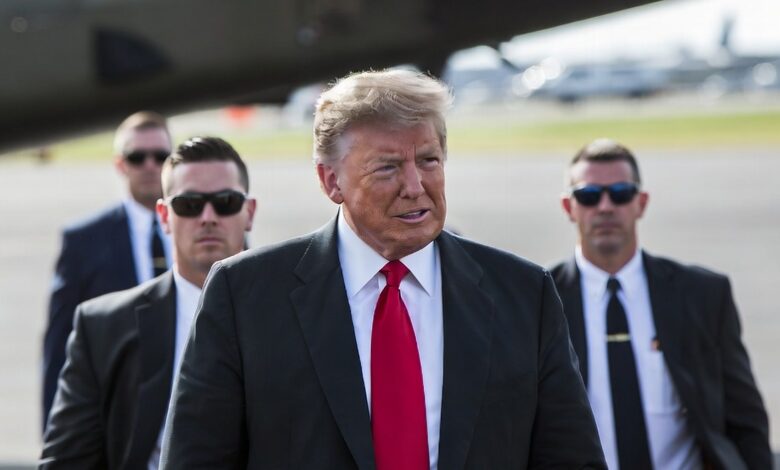
Which brings us to a curious confession from a veteran Secret Service agent who, after protecting multiple presidents, said something that startled people who understand how that world usually works.
He said Donald Trump “ruined” him for the job.
Not because Trump was difficult. Because Trump was different.
The story, which circulated online through a viral post recounting the agent’s remarks reads less like a political testimonial and more like something you’d hear at a retirement dinner. The agent explained that throughout his career he had done what Secret Service agents are trained to do: maintain discipline, maintain distance, maintain professionalism. Protect the principal. Stay invisible.
Presidents, for their part, usually kept the relationship just as formal.
“Agent.” Not a name. A role. And then came Trump.
According to the account, Trump learned the agent’s name. Not only his name, but his wife’s name. His children’s names. Trump asked about the agent’s son’s baseball games. He noticed when agents had been standing for hours and told them to sit down. On long days, he reportedly ordered extra food and told staff to make sure the agents ate first.
The agent’s conclusion was almost comically simple: Trump had ruined him.
Because after being treated like a human being, it was hard to go back to being treated like part of the furniture.
Now, if you’ve spent any time in politics, you’ll recognize immediately why this story resonates. Washington has produced generations of leaders who speak endlessly about “the little guy” while simultaneously stepping over the very people standing three feet away from them.
Politics, after all, has perfected the art of symbolic empathy.
But genuine personal attention? That’s rarer than a balanced federal budget.
Which is why this story about a Secret Service agent carries more weight than the typical political anecdote. These men and women exist in the strange twilight zone of public service. They are everywhere and nowhere at the same time. They stand inches away from the most powerful figures on earth, yet the job requires them to behave like ghosts.
Most Americans couldn’t name a single Secret Service agent.
And presidents often can’t either.
Historically, presidents have had wildly different reputations with the people tasked to protect them. Agents who served Ronald Reagan frequently described him as warm and approachable. George W. Bush earned similar praise, largely because of his habit of greeting agents by name and chatting with them during long travel days.
Others, well… let’s say their reputations didn’t exactly produce standing ovations at Secret Service reunions.
Power has a way of shrinking a person’s field of vision.
When aides handle every detail of your life, when staff members clear hallways before you walk through them, when your schedule is engineered down to the minute, it becomes easy to forget that the people orbiting around you are actual human beings.
They become functions. Roles. “Agent.”
The irony surrounding Donald Trump is that his critics have spent nearly a decade portraying him as uniquely arrogant or self-absorbed. Yet stories from the people who interact with him behind the velvet rope often tell a different tale. Staffers from his hotels have described him remembering their names months later. Workers at Mar-a-Lago have recounted him asking about their families. Even construction workers from his early real-estate days have told stories about Trump visiting job sites and speaking with laborers directly.
These stories rarely make headlines, of course. Modern political coverage prefers drama. And drama sells better than decency.
But if you look closely at Trump’s personal history, the behavior described by the Secret Service agent actually fits a pattern. Trump grew up in the rough-and-tumble world of New York construction, where billion-dollar deals often required negotiating directly with electricians, ironworkers, and foremen who could shut down a project if they felt disrespected.
In that environment, remembering someone’s name wasn’t just polite.
It was practical.
Contrast that with the more aristocratic wing of American politics, where leaders sometimes move through life surrounded by staff who buffer them from ordinary interaction. The result can feel less like leadership and more like royalty.
Which brings me to a personal observation.
I happen to know several Secret Service agents myself. Over the years I’ve heard stories that never make the news, stories about what presidents are like when the cameras disappear and the motorcade doors close. Some presidents earn quiet admiration from the agents who protect them. Others earn polite silence.
And if you understand federal culture, you know that silence can speak volumes.
One friend of mine once told me about his assignment protecting Hillary Clinton. He described the experience with a mixture of professional restraint and the kind of exhausted tone usually reserved for people who just finished jury duty in a case involving twenty-seven accountants and a box of spreadsheets.
Let’s just say the enthusiasm level was not exactly through the roof.
I joked with him that protecting Hillary must be the Secret Service equivalent of getting caught speeding and being sentenced to administrative purgatory. You know the kind of assignment that gets handed out after someone upstairs says, “You know what would build character?”
Protecting Hunter Biden, by contrast, might require a different skill set entirely. Possibly including the ability to keep a straight face while explaining to your supervisor why the principal’s laptop has become an international diplomatic incident.
But jokes aside, the deeper point here has nothing to do with personalities and everything to do with leadership.
Leadership reveals itself in small moments. Not in the speeches written by staffers, nor in the carefully staged photo-ops. But in the quiet interactions nobody thinks to film.
When the Secret Service agent described Trump attending his father’s funeral without cameras or press, that detail mattered more than the rest of the story combined. Washington is a town obsessed with optics. If something good happens, there is usually a press release, a photographer, and a social media team standing nearby.
But according to the story, Trump simply showed up.
No cameras.
No announcement.
Just respect.
That kind of gesture has a strange power in politics because it bypasses the usual machinery of public relations. It’s not designed for applause, which means the applause becomes genuine when the story eventually leaks out.
And that brings us back to the agent’s comment that Trump “ruined” him.
What he meant was simple.
Once someone raises the standard of basic human decency, it becomes impossible to pretend the lower standard was acceptable.
If you’ve ever worked for a boss who genuinely respected you, you know exactly what that feels like. You suddenly realize how many workplaces operate on indifference. You notice the difference between leadership and management, between people who inspire loyalty and people who merely collect compliance.
Trump’s supporters often say this quality is part of what makes him so effective politically. He projects the sense that he sees people others overlook. Whether it’s factory workers in the Midwest, small-business owners buried under regulations, or the security agents quietly standing behind him at events, the message is the same.
You matter.
Naturally, critics dismiss stories like this as hero worship. They accuse Trump supporters of turning him into a cult figure, as if admiration must always be irrational when it flows toward someone they dislike.
But there’s a flaw in that argument. Respect is not the same thing as worship. And noticing someone’s character is not the same thing as blind loyalty.
The reality is that people tend to admire leaders who treat others well. It’s a remarkably old-fashioned concept, which might explain why it feels so refreshing in modern politics. We’ve spent decades watching leaders lecture the public about compassion while displaying very little of it in private.
Then along comes a president who remembers the names of the people guarding the door.
And suddenly a Secret Service agent says he’s been ruined.
If that sounds like a strange complaint, consider the alternative.
Imagine going back to a job where you are once again addressed only by your title. Where your family is invisible. Where your name exists only on a badge clipped to your jacket.
In Washington, that’s the norm.
But every once in a while someone raises the bar high enough that the norm starts to look embarrassingly small.
That, apparently, is what happened to this Secret Service agent.
Donald Trump didn’t ruin the job.
He ruined the illusion that the job had to feel that way in the first place.