
There’s a particular kind of silence in politics that doesn’t show up on microphones, doesn’t trend on social media, and doesn’t get packaged into neat, outraged soundbites for cable news.
It’s the silence of the stab in the back.
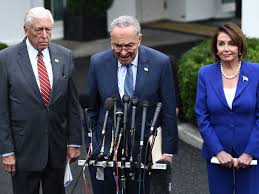
And in the case of Chuck Schumer, it’s insiders counting votes behind closed doors, and former allies suddenly developing “scheduling conflicts.” I’m willing to bet that the Senate chamber gets quieter when Schumer walks in. And in that silence one can hear the clock ticking for Chucky.
Listen closely enough, and you can almost hear the Democratic Party asking itself a question it hoped it would never need to answer: how did we get here…again?
Because the problem for Democrats isn’t just about Schumer. It’s about a pattern. A recurring nightmare where leadership lingers past its expiration date, propped up by habit, fear, and the political equivalent of “let’s just get through the holidays and then we’ll deal with it.” Only the holidays never come, but the bill always comes due.
Let’s start with the obvious contradiction. Because it sits in the middle of the room like a pink elephant wearing a “Midterm Victory” t-shirt.
If Democrats are so confident about their chances in the upcoming elections, why did their more radical candidates, the ones loudly backed by “the future of the party,” get steamrolled in the primaries? Not edged out. Not narrowly defeated. Torched. Politically incinerated like marshmallows held too long over a campfire of bad ideas.
Those losses were not a messaging problem, but instead a total rejection.
And when the base starts rejecting the product, the next logical step is to look at management.
Schumer has begun looking less like a Senate leader and more like a man trying to keep a dozen spinning plates from crashing while juggling chainsaws.
Behind the scenes, according to reports, conversations aren’t just happening…they’re metastasizing.
Quiet vote counts. Private dinners. Strategic denials that feel less like truth and more like someone carefully stepping around a landmine. Even Chris Murphy, who attempted to downplay the chatter, inadvertently confirmed the one thing leadership dreads most: the conversation has moved from “Is there a problem?” to “How many votes do we need?”
And once you start counting votes against your own leader, you’re no longer discussing hypotheticals. You’re drafting an exit plan. For him.
What makes this moment particularly rich, almost operatic in its irony, is how familiar it feels.
Democrats, who spent years assuring the public that everything was fine, that concerns were overblown, that leadership was steady and capable, now find themselves replaying the same script with different actors. The names change. The tone doesn’t.
It’s the political version of “I couldn’t fix your brakes, but I made your horn louder.”
But Schumer’s dilemma is uniquely punishing because he isn’t just dealing with internal dissatisfaction. He’s trapped in a vice grip of competing impossibilities.
On one side, a progressive wing that treats compromise like a moral failing, demanding policies that play well on Twitter but collapse under the weight of reality. On the other, the inconvenient presence of Donald Trump, whose political resilience continues to scramble Democratic strategies like a dropped jigsaw puzzle.
Because here’s the part no one in Democratic leadership wants to say out loud: Trump didn’t just come back. He came back bigger and better.
And effectiveness is kryptonite to a party that has built much of its modern identity around opposition rather than execution. It’s hard to run against a man when he’s producing results people can measure in their daily lives. It’s even harder when your own party can’t agree on what it stands for beyond not being him.
So Schumer finds himself performing a kind of political tightrope act, except the rope is fraying, the wind is picking up, and half the audience is actively rooting for him to fall so they can take his place.
And yet, the most telling part of this entire saga isn’t the dissatisfaction itself. Political parties are always dissatisfied. It’s their native state. The telling part is the timing.
This should have been done much sooner
Why, after years of policy misfires, messaging confusion, and internal factionalism, does the breaking point arrive at this particular moment?
The answer, inconvenient as it may be, is that reality has a way of ignoring narratives. You can spin polling data and massage headlines. You can even convince your own base that setbacks are victories if you squint hard enough. But eventually, voters make decisions that don’t care about your talking points.
And when those decisions start stacking up in ways that contradict your internal story, something has to give.
In this case, that “something” appears to be Schumer.
There’s also a deeper historical rhythm at play here, one that stretches beyond any single politician. Political parties, much like aging rock bands, often struggle to recognize when their lead singer can no longer hit the high notes. The crowd notices first. Then the critics. Eventually, even the band members start exchanging glances mid-performance.
But nobody seems to want to be the first to say it out loud.
Because saying it out loud means acknowledging failure. It means admitting that the strategy, the leadership, the direction…something fundamental isn’t working. And in politics, where perception often masquerades as reality, that kind of admission can feel more dangerous than the problem itself.
So instead, you get whispers. You get anonymous sources. You get carefully worded statements that sound like support but read like eulogies in disguise.
“Still has the backing of the caucus” is Washington-speak for “we’re not ready to push him off the cliff just yet.”
And make no mistake, cliffs are involved.
What’s particularly striking, almost darkly comedic, is how predictable this arc has become. The same party that once circled wagons around struggling leadership figures now finds itself quietly sharpening knives. Nevertheless, Democrats insist publicly that everything is under control.
I see this as less a governing strategy and more a long-running stage play where the actors keep forgetting their lines.
Meanwhile, voters watch, increasingly detached, as the performance unfolds.
And hovering over all of this, like a ghost that refuses to be exorcised, is the simple fact that none of these internal struggles exist in a vacuum.
Every ounce of energy spent on leadership intrigue is energy not spent on governance. Every whispered conversation about ousting Schumer is a tacit admission that the party’s focus has drifted inward at precisely the moment it needs to project strength outward.
Which brings us back to the original question, the one that started this unraveling: if victory is so assured, why does leadership look so fragile?
The answer, stripped of spin and dressed in plain language, is that confidence doesn’t behave like this. Parties on the verge of triumph don’t quietly plot leadership changes. They consolidate. They project unity. They move forward with purpose.
What we’re seeing instead is hesitation dressed up as strategy.
And Schumer, for all his years of experience, now embodies that hesitation. Not because he created it single-handedly, but because he can no longer contain it. He’s become the focal point for frustrations that have been building for years, the political equivalent of a dam that’s starting to show cracks after too many storms.
At some point, the question won’t be whether he should step aside. It will be whether the party can afford to wait any longer.
Because politics, like gravity, has a way of accelerating once things start falling.
And right now, the room is getting very, very quiet. So quiet, I hear the ghost of Joe Biden.