
Try, for a moment, to imagine the emotional freefall of the modern Left.
Not the polite kind of disappointment where a candidate loses an election and retreats to write a memoir about “what democracy means to me.” No. Think bigger. Think more dramatic. Imagine standing proudly at the peak of cultural Mount Everest, wind in your hair, cameras flashing, journalists scribbling your every syllable as if you were Moses returning with tablets… and then suddenly someone drop-kicks you off the summit.
That, more or less, is what the past decade has felt like for the American political and cultural establishment.
Because for a very long time, these people believed the game was over. The deal was done. History had signed the paperwork. America was headed toward a permanent progressive consensus in which elections would still occur, of course, but mostly as ceremonial exercises… something like choosing the flavor of cake at a wedding where the marriage had already been arranged.
Then along came Donald Trump, a man who did not politely wait his turn, did not respect the velvet ropes around elite power, and most certainly did not ask permission before rearranging the entire stage.
And suddenly, the people who believed they owned the theater discovered the audience had other plans.
The Political Class and the Broken Line
Let’s begin with the politicians.
Inside Washington, power has traditionally worked like a deli counter. You take a number, wait patiently, shake the right hands, kiss the right rings, and eventually the system calls your turn.
Republicans had perfected this ritual. Years of committee work, donor dinners, and polite speeches about fiscal restraint had positioned a long line of ambitious figures who assumed the presidency would eventually rotate to them.
Then Trump walked in, grabbed the sandwich off the counter, and ate it while the line was still arguing about mustard.
The resulting shock among establishment Republicans was something between betrayal and existential confusion. These were people who had followed the rules. They had spent decades climbing ladders constructed entirely out of cocktail receptions and donor golf tournaments. And suddenly a real estate developer from New York bulldozed through their carefully choreographed hierarchy.
Even now, many of those so-called “RINOs” still haven’t recovered from the trauma of watching their carefully planned political careers get leapfrogged by a man who treated the entire process like an open-mic comedy night.
Democrats, meanwhile, faced a different nightmare.
For them, the problem wasn’t just losing elections. It was losing momentum at the exact moment they believed permanent control was within reach.
After decades of expanding federal bureaucracy, tightening media alliances, and cultivating a cultural apparatus that stretched from Hollywood to academia, many on the Left believed they were one election cycle away from cementing a political environment where the opposition could never quite win again.
Not because voting would disappear. That would be too obvious.
Instead, voting would continue in the way Soviet elections continued: technically present, emotionally irrelevant.
Then Trump happened. And suddenly the carefully constructed machinery began to sputter.
Celebrity Authority Meets Reality
But politics is only one pillar of modern progressive power. The other pillar, perhaps even more influential, has been celebrity culture.
For decades Americans were told that actors, singers, and athletes were not merely entertainers. They were moral authorities. Cultural sages. People whose opinions on geopolitics, climate policy, or tax law deserved serious national attention.
Hollywood, naturally, loved this arrangement. When the political Left gained power, the relationship became symbiotic. Celebrities validated politicians. Politicians elevated celebrities. Everyone attended the same galas and fundraisers, nodding approvingly while congratulating one another for “speaking truth.”
Then Trump started ridiculing them.
Relentlessly.
It turns out nothing punctures the aura of celebrity quite like being mocked in front of millions of voters who suddenly realize that the emperor’s tuxedo may not contain an emperor.
Consider Robert De Niro, once one of the most respected actors in American cinema. The man who starred in films like Taxi Driver and Raging Bull built a career on portraying complex, intimidating characters.
Yet somewhere along the road, he transformed into a political caricature whose most memorable performances now involve shouting at microphones about Trump.
Then there’s Alec Baldwin, whose once-towering Hamptons estate reportedly dropped from roughly $29 million to about $21 million while lingering on the market for years. When even real estate begins behaving like a political polling number, you know something unusual is happening.
And the trend doesn’t stop there.
Hollywood award shows that once dominated American living rooms now drift through the calendar with the cultural impact of a library committee meeting. The Academy Awards, once a national event families gathered around the television to watch, has become so culturally distant that many Americans only realize it happened after seeing a stray headline the next morning.
When my wife recently mentioned the Oscars were on, her reaction summed up the new reality perfectly.
“I don’t know a single movie that was nominated or won.”
That sentence, spoken casually over dinner, would have been unimaginable twenty years ago.
The Vanishing Authority of Late Night
Television provides another fascinating case study.
Late-night hosts once wielded enormous cultural influence. Johnny Carson could shape national conversations with a monologue. Even into the 2000s, these shows maintained audiences that stretched across the political spectrum.
But once the format shifted from comedy to nightly political lectures, something peculiar happened.
The audience shrank.
Shows that once competed for the entire American public suddenly began speaking almost exclusively to a narrow ideological audience. Ratings followed accordingly.
Stephen Colbert, whose program The Late Show with Stephen Colbert became synonymous with anti-Trump commentary, has faced constant scrutiny over ratings declines as the broader late-night ecosystem struggles to retain viewers in the streaming era.
The irony, of course, is delicious.
In attempting to dominate the cultural conversation, late-night television ended up shrinking its own stage.
Obama and the Quiet Library
Perhaps no example illustrates the shift more clearly than the trajectory of Barack Obama.
When Obama burst onto the national scene in 2008, the political world treated him like a generational phenomenon. Crowds gathered by the tens of thousands. Media coverage bordered on reverence. He was described as a transformational figure who would reshape American politics for decades.
Yet fast forward to the unveiling of the Obama Presidential Center, and the biggest headline surrounding the event was not the library itself but the revelation that Trump was not invited.
Think about that.
A presidential library opening, an event traditionally treated as a historical milestone, became a news story largely because of someone who won’t be there.
Why? Well it’s not what one might think.
The fact is, if Trump were present, the gravitational pull of media attention might shift entirely toward him. And Obama’s fragile ego would never risk being overshadowed at his own monument.
When it comes to Obama’s rise and fall, history has a wicked sense of humor.
The Empty Bench
Look across the current Democratic landscape and try to identify a single figure capable of electrifying the national imagination the way Obama once did.
Chuck Schumer and Nancy Pelosi are relics. And despite the hype, Alexandria Ocasio-Cortez is a joke for the rest of America.
Democrats have no one who can electrify an audience like Trump. And at the appropriate time, Trump will name his heir-apparent, and that person will inherit the throne.
For Democrats, the bench in political terms looks remarkably thin.
The Media’s Fading Titans
The same phenomenon appears in journalism.
Once-towering media figures such as Rachel Maddow or Anderson Cooper still command platforms, but their influence operates inside a shrinking ideological bubble rather than across the broader American landscape.
Cable news itself faces declining viewership as audiences migrate to digital platforms and independent media voices.
The old gatekeepers, it seems, have misplaced the gates.
The Meritocracy Problem
Meanwhile, a curious shift has occurred in sports and entertainment.
The athletes capturing global attention today tend to avoid political theater altogether.
Fans follow Formula 1 drivers and international soccer stars not because of their policy opinions but because of their skill. Performance determines popularity. The scoreboard settles debates.
Meritocracy, in other words, has quietly returned to the spotlight.
And meritocracy is notoriously uncooperative when activists attempt to control it.
The Trump Effect
All of this helps explain the intense hostility directed toward Trump.
For many figures across politics, media, and entertainment, his presence represents more than a political disagreement. It represents a disruption of the ecosystem that once elevated them.
Attention, after all, is the most valuable currency in modern culture.
Trump possesses an almost supernatural ability to generate it.
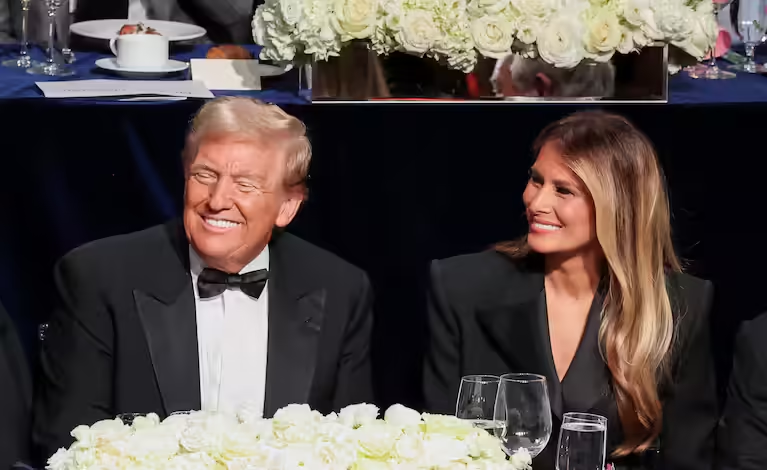
He draws crowds larger than most entertainers. He dominates headlines even when he isn’t speaking. And when he walks into a room full of political or cultural elites, the center of gravity tends to shift immediately toward him.
Imagine being someone who spent decades cultivating fame only to discover that a single figure can eclipse it simply by existing.
That kind of eclipse does not produce calm reflection.
It produces fury.
The Long Descent
In truth, what we’re witnessing may be less a sudden collapse than a gradual recalibration.
For decades the Left occupied the commanding heights of American culture. Politics, media, entertainment, academia, and corporate messaging aligned in ways that created the impression of near-total dominance.
But cultural authority is a fragile thing. It depends entirely on public belief.
Once that belief weakens, the fall can be dramatic.
Today many of the figures who once dominated the conversation now struggle to command attention outside their own ideological circles.
The audience has drifted elsewhere.
And for people who built entire careers around the assumption that the spotlight would never move, that realization must feel like being launched off the summit of Everest with no rope in sight.
Because when the crowd stops cheering, the silence can be deafening.