

There’s a particular kind of irony that doesn’t tap you on the shoulder politely. It kicks the door in, rearranges your furniture.
America finds itself in 2026 staring at our own reflection like we just met a stranger who knows all our secrets.
Because while half the country argues about policy, the other half seems to be reenacting history without realizing it’s wearing the villain’s costume from the first act.
Now, before anyone reaches for their preferred outrage button, let’s ground this in something real. America didn’t emerge from a group hug. It was carved out of chaos, ambition, and—yes—conflict that would make modern sensibilities recoil like a cat near a bathtub.
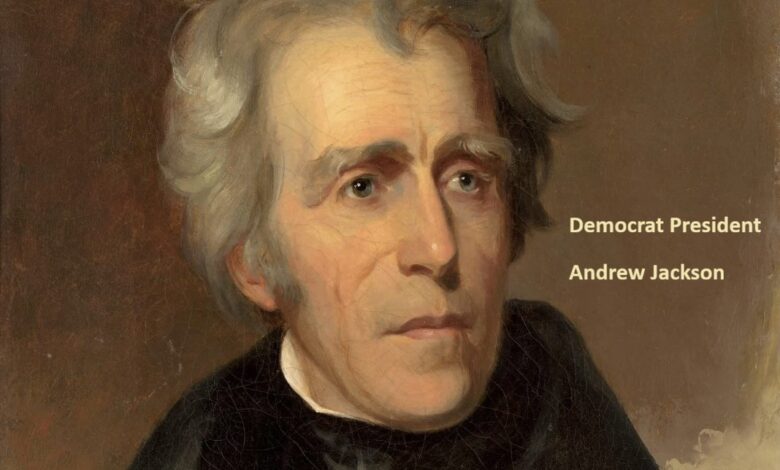
Take Andrew Jackson, a man who embodied contradiction like it was a job requirement. War hero of the War of 1812, particularly at New Orleans, where he delivered a lopsided defeat to the British that helped cement America’s independence. At the same time, he was a slave owner, an architect of Indian removal policies, and a man whose personal code of justice made “subtlety” sound like a foreign language.
History books often present him like a cracked statue: half revered, half condemned. But statues don’t bleed, and Jackson’s era absolutely did.
When you walk through his plantation, The Hermitage, you’re not stepping into nostalgia. You’re stepping into a reality where moral contradictions weren’t hidden…they were furniture. Letters displayed on the walls reveal a man who could gift a human being as a wedding present to his son without a flicker of societal backlash. Not because it was right, but because it was normal.
And that word—normal—ought to make you uncomfortable. It should. Because it forces a question most people would rather dodge: what are we normalizing today that future generations will look back on with disbelief?
Jackson’s conflicts with Native Americans, often framed as brutal and unforgiving, didn’t occur in a vacuum. There were attacks on settlers, retaliations, escalating cycles of violence that resembled less of a policy debate and more of a frontier pressure cooker. When the smoke cleared, Jackson didn’t just win battles—he reshaped the demographic and political landscape of an entire region.
Even figures like Davy Crockett, who opposed aspects of Jackson’s Indian policies, found themselves swept into the same historical tide. Crockett, often romanticized as a rugged individualist, understood that expansion came at a cost. He just didn’t agree with how steep that cost needed to be.
Fast forward to today, and here’s where the script flips in a way that would make a screenwriter blush.
Modern progressives spend a remarkable amount of time condemning America’s founding as an exercise in conquest, colonization, and displacement. Those criticisms, while often selectively framed, at least acknowledge the harsh realities of history. Yet, in a twist that feels less like irony and more like performance art, many of those same voices advocate for border policies that effectively erase the concept of national sovereignty altogether.
Which raises a question that doesn’t get asked nearly enough: if borders were tools of oppression then, what exactly are they now?
Because if a nation has no meaningful border, it doesn’t have immigration—it has migration. And migration, unmanaged and unstructured, doesn’t just change a country. It transforms it in ways that are rarely reversible.
According to data from U.S. Customs and Border Protection, recent years have seen millions of encounters at the southern border, with numbers that would have been considered unimaginable just a decade ago. You don’t need a political science degree to understand that scale matters. A trickle is a policy discussion. A flood is a reality check.
And this is where Donald Trump enters the frame—not as a historical figure, but as a modern disruptor who looked at the situation and said, in essence, “Maybe we should have a country.”
Simple idea. Controversial execution.
Trump’s approach to immigration, particularly his emphasis on border enforcement, wasn’t just about policy—it was about redefining the conversation. While critics framed his stance as harsh or exclusionary, supporters saw it as a necessary recalibration, a return to the basic premise that a nation-state has both the right and the responsibility to control its borders.
Now here’s where the comparison gets interesting—not because it’s identical, but because it rhymes.
If you strip away the historical specifics and look purely at the dynamics, early Americans fought to establish control over land, resources, and identity. Native Americans resisted that encroachment, seeking to preserve their way of life against an advancing force that didn’t plan on stopping.
Today, many Americans feel a different kind of pressure—not from cavalry units or land treaties, but from policies that seem to prioritize global movement over national cohesion. The tools have changed. The outcome, some argue, could feel eerily familiar.
And yet, pointing this out tends to trigger a reaction that’s less about debate and more about dismissal. Because acknowledging the parallel would require confronting a deeply uncomfortable possibility: that history doesn’t just judge the past—it foreshadows the future.
Of course, the comparison isn’t perfect. History rarely offers clean analogies. But imperfection doesn’t invalidate the question—it sharpens it.
If protecting land and culture was once considered a fundamental right, when did it become a controversial stance?
If enforcing borders is now viewed as inherently unjust, does that mean every nation on Earth is operating under a moral deficiency? Or is the criticism selectively applied, depending on which political narrative is being served?
And perhaps the most unsettling question of all: are we witnessing a slow-motion inversion of historical roles, where the descendants of those who once expanded without restraint are now expected to accept limitless expansion within their own borders?
Because if that’s the case, then the debate we’re having isn’t just about immigration. It’s about identity, continuity, and the definition of a nation in an era where those concepts are increasingly treated like outdated software.
Now, none of this absolves the past. Andrew Jackson doesn’t get a historical pardon because modern politics found a new contradiction. His actions remain what they were—decisive, controversial, and, by today’s standards, often indefensible.
But history isn’t a courtroom where we only prosecute the dead. It’s a mirror, and right now, that mirror is reflecting something many people would rather not see.
Which brings us back to Trump.
Whether you view him as a necessary correction or a disruptive force, his presidency forced a question into the national conversation that refuses to go away: what does it actually mean to be a country?
Because without an answer to that, every other policy discussion becomes a side quest in a game nobody’s actually playing to win.
And while the political Left continues to frame border enforcement as regressive, the practical reality remains stubbornly indifferent to ideology. Nations that fail to define and defend their boundaries don’t evolve into utopias. They dissolve into ambiguity.
History has examples. Plenty of them.
The Roman Empire didn’t collapse because it ran out of ideas. It collapsed because it lost the ability to maintain cohesion—politically, culturally, and yes, territorially.
Empires fade. Nations fracture. And through it all, the people living in those transitions rarely recognize what’s happening until it’s already in motion.
So here we are, standing at a moment where the past and present are having a quiet conversation, and most people are too busy arguing to listen.
Maybe the real lesson isn’t about choosing sides in a historical debate. Maybe it’s about recognizing patterns before they solidify into outcomes.
Because if history teaches anything, it’s this: the roles may change, the language may evolve, but the consequences tend to stick the landing.
Is America writing a new chapter or revisiting an old one?