

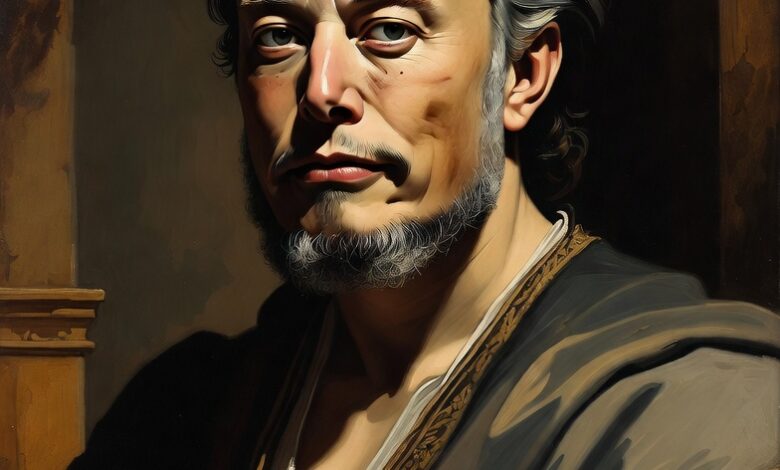
News that Elon Musk has become the world’s first trillionaire sent America’s professional complainers scrambling for their microphones.
To hear some politicians tell it, civilization now faces its greatest threat since the asteroid that wiped out the dinosaurs. The biggest existential threat has moved from global climate change, war, debt, China, Russia, terrorism, MAGA to Elon Musk.
The response from the Left was predictable.
Elizabeth Warren reacted to the Space X IPO as though Musk had announced plans to purchase the moon and convert it into luxury parking.
Elon Musk just became the world’s first trillionaire.
The typical American household would have to work more than 11 MILLION years to make Elon Musk’s level of wealth.
We need a wealth tax.
— Elizabeth Warren (@SenWarren) June 12, 2026
And her response raised a question nobody seems interested in asking:
Why are the people most offended by extraordinary achievement so often the people least capable of achieving it themselves?
That question isn’t limited to Warren, as it mirrors that of many of her contemporaries.
Take a stroll through Washington and you’ll discover a fascinating ecosystem. The city is packed with people who have spent decades discussing economic growth while contributing little to it.
Leftists regulate industries they’ve never worked in, lecture entrepreneurs they’ve never resembled, and conduct hearings on innovation using technology they barely understand.
Yet somehow they have appointed themselves judges in the case of Elon Musk versus Success.
Imagine attending a piano recital and discovering the harshest critic in the audience has never touched a piano. He cannot read music, has never composed anything, and has never performed. His greatest contribution to the art form is filing noise complaints.
Critics are entitled to their opinions.
Whether they should be viewed as authorities is another matter entirely.
Musk’s critics often speak as though wealth emerges from a dark and mysterious process. Money simply appears. Fortunes materialize. Billionaires awaken one morning to discover another billion has landed in their checking account like an especially fortunate pigeon.
AOC with zero life achievements: “Elon Musk is not a scientist, he’s not an engineer, he’s a billionaire conman with a lot of money” 🤡
Elon Musk: “Can you believe it? That’s crazy, anyway… what did you get done this week?” pic.twitter.com/iiBaDClXB6
— SMX 🇺🇸 (@iam_smx) March 8, 2026
The reality is considerably less magical.
Musk spent years being mocked.
Tesla was supposed to fail.
SpaceX was supposed to fail.
Starlink was supposed to fail.
His acquisition of X was supposed to fail.
Many of the same people who now complain about his wealth spent years predicting his collapse.
Their forecasts have aged with all the grace of yogurt left on a Phoenix sidewalk in July.
What’s fascinating isn’t that they were wrong.
Everyone is wrong sometimes.
What’s fascinating is that being wrong appears to have increased their confidence.
Most professions punish failure.
If a surgeon repeatedly operates on the wrong kidney, people become concerned.
If a meteorologist predicts sunshine during a hurricane, viewers become skeptical.
Political punditry and government criticism seem to operate under different rules.
In politics, being spectacularly incorrect merely qualifies you to make larger predictions.
Somewhere along the way, America developed a strange habit of confusing wealth creation with wealth transfer.
The distinction matters.
A politician who secures a subsidy has transferred wealth, as does a lobbyist who wins a special exemption has transferred wealth.
A consultant who receives millions from a government program has transferred wealth.
However, a creator who builds products people voluntarily purchase has created wealth.
Those are not remotely the same activities.
One resembles baking a pie. The other resembles arguing over who gets the largest slice.
Yet politicians routinely speak as though both activities deserve identical moral treatment.
This may explain why Musk is so irritating to them.
He keeps exposing the difference.
His companies manufacture products. They solve problems. They create markets that didn’t previously exist.
Meanwhile, many of his loudest critics operate within a system where success is measured by appropriations, regulations, committee assignments, and appearances on cable television.
One side builds rockets, while the other builds talking points.
Those achievements are not interchangeable.
AOC declared recently that no human being can possibly earn a billion dollars.
That argument has always fascinated me because it requires a curious assumption. Specifically, that value creation has a ceiling.
Apparently there exists some invisible point at which society should announce, “You’ve helped enough people. Please stop.”
Had this philosophy existed throughout history, somebody would have informed Henry Ford that transportation innovation was becoming excessive.
Thomas Edison would have received a warning letter after bulb number 500,000.
Steve Jobs would have been advised that personal computers were fine, but perhaps he should leave phones alone because things were getting a bit lucrative.
Fortunately for humanity, creators rarely ask permission from spectators.
Musk represents an especially uncomfortable example because he has succeeded across multiple industries.
Most entrepreneurs spend a lifetime mastering one field.
Musk looked at automobiles, aerospace, communications, artificial intelligence, energy storage, and robotics and apparently decided sleep was overrated.
His critics react to this the way medieval villagers might react to witnessing a jet aircraft. They aren’t sure what they’re seeing, but they know somebody should probably tax it.
Then there is the matter nobody mentions.
Musk creates millionaires.
Lots of them.
Engineers, managers, investors, and employees. I heard that the cooks at Space X are now millionaires.
Add contractors, and you see the impact of his invention. Entire communities have benefited from companies he helped build.
Yet when politicians discuss wealth, the conversation usually begins and ends with the person at the top.
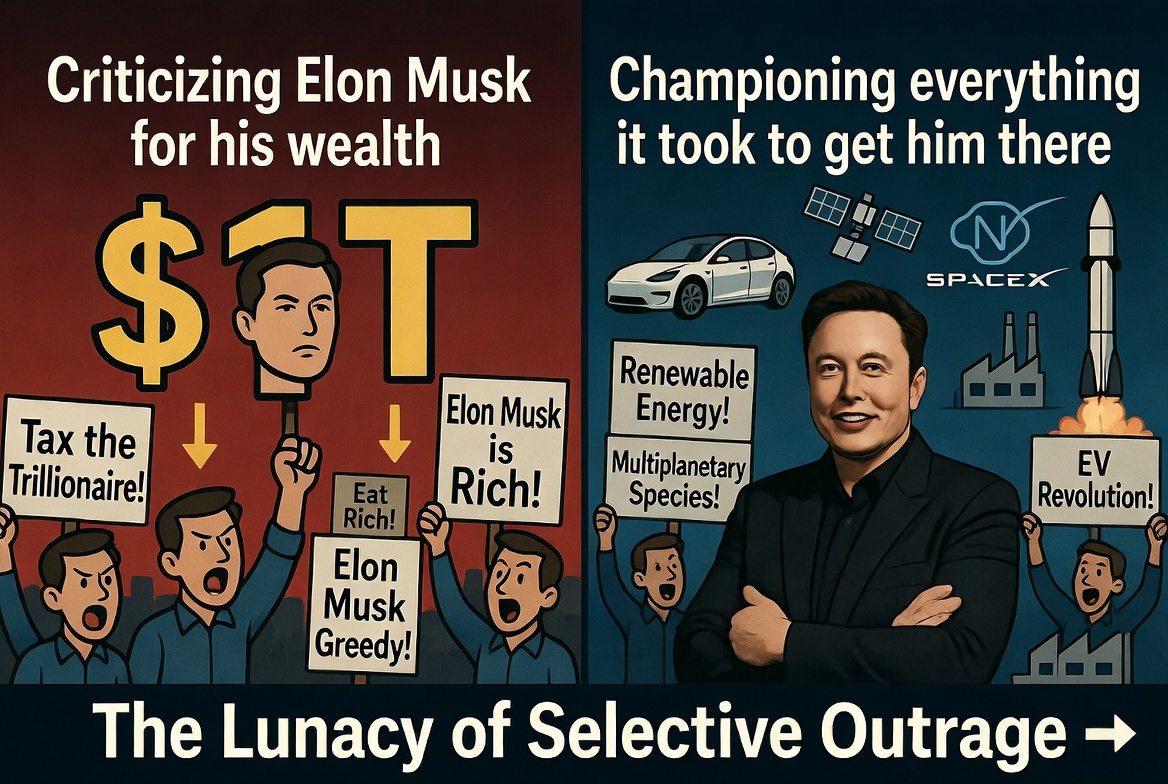 This is like examining a forest by studying one tree.
The ecosystem disappears.
The jobs disappear.
The innovation disappears.
The opportunities disappear.
All attention focuses on the tallest branch.
That’s not analysis.
That’s envy disguised as public policy.
Perhaps the most revealing aspect of the anti-Musk crusade is what it says about modern attitudes toward achievement.
America once admired builders.
Not because they were perfect, nor were they saints. In fact, many weren’t.
The admiration came from recognizing that civilization advances through people willing to attempt absurd things.
Flying machines once sounded absurd. Electric cars sounded absurd, as did reusable rockets.
Landing boosters vertically on floating platforms sounded like something conceived during a caffeine overdose.
Then somebody did it.
The proper response to that and other accomplishments should be wonder.
Instead, many political leaders seem determined to treat exceptional achievement as evidence requiring prosecution.
That instinct is dangerous.
Civilizations rise when creators become cultural heroes. But civilizations stagnate when creators become public enemies.
History offers plenty of examples, and the lesson is remarkably consistent.
Societies that celebrate innovation get more of it.
Societies that punish innovation eventually discover that talent has other places to go.
Whether Musk ultimately becomes a trillionaire is almost beside the point.
The number itself is merely an accounting curiosity.
The more revealing story is the reaction.
A man spends decades building companies that transform industries, and the first impulse of many politicians is not to ask how he did it.
Their first impulse is to ask how to stop the next person.
That’s the difference between creators and spectators.
Creators look at success and wonder how it happened.
Spectators look at success and wonder how to regulate it.
One mindset builds the future.
The other schedules a hearing about it.