
A bison has no interest in your social media presence.
It doesn’t care how many followers you have, what your politics are, or whether your camera has portrait mode. It isn’t impressed by hashtags. It has never paused to admire a carefully curated Instagram feed. It certainly isn’t waiting for permission from Human Resources before expressing its feelings.
A bison has one remarkable quality that has become surprisingly rare in modern society: it tells you exactly where the boundary is.
Cross it, and the meeting is over.
The now-viral video making the rounds captures a scene that has become almost routine in the smartphone era.
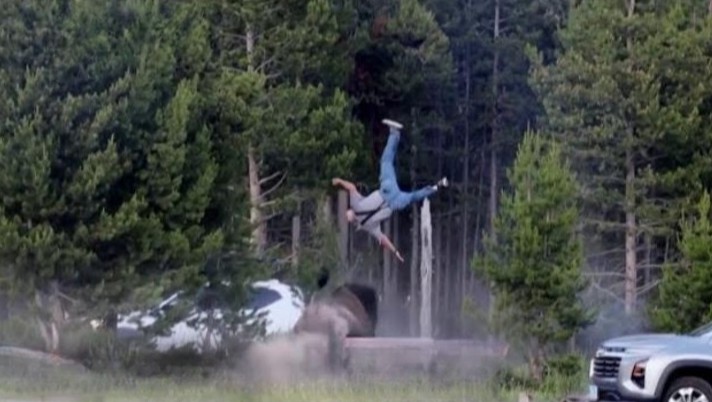
A tourist was seriously injured after a bison tossed them about 8 feet into the air in Yellowstone National Park. The attack was captured on video by photographer Mike Macleod. pic.twitter.com/ZtGTb32Gee
— Breaking911 (@Breaking911) July 12, 2026
A massive bull bison is resting peacefully while a couple decides to stop and photograph the beast. The animal begins rolling on the ground, the equivalent of hanging a giant neon sign that reads, “Today’s office hours are closed.”
The couple lingered a bit too long, so the bison decides it’s time to add another page to the book: Stupid Things White People Do.
The bison rises.
And Mother Nature sighs the sigh of a parent who has watched a toddler discover electrical outlets.
A passing pickup creates a brief opening for escape, as the bison looks for the interlopers. Trees interrupt the camera’s view, and for a few glorious seconds, it appears stupidity may pull off an upset victory.
Then the man breaks from cover. He races toward an SUV that appears to offer some help.
Too late.
The bison lowers his head and Newtonian physics hits the man with the subtlety of a wrecking ball. The old guys gets launched skyward like a Roman candle.
The remarkable thing isn’t that the bison charged, it’s that anybody would be surprised.
Civilization has become astonishingly good at convincing us that consequences are optional.
We’ve wrapped dangerous things in comforting stories for so long that we occasionally forget the original product.
Bears become park rangers. Sharks become misunderstood celebrities with merchandise. Dinosaurs were purple and put on children’s lunch boxes.
Even wolves eventually get animated musicals.
Reality, meanwhile, never signed the licensing agreement.
There’s a broader lesson hiding behind the flying tourist.
Modern culture often mistakes appearances for substance. If something looks approachable, we assume it is. If an idea sounds compassionate, we assume it’s practical. If someone promises paradise with no sacrifice, we stop asking where the invoice eventually lands.
History is littered with beautiful sales brochures attached to terrible products.
The twentieth century alone produced enough examples to fill libraries. Grand economic promises regularly collided with stubborn realities about incentives, human nature, and the impossibility of legislating away scarcity. Every generation seems convinced it has finally discovered the version that will work this time, usually because this version has newer branding and a better logo.
Rebranding is one of humanity’s oldest hobbies. Hollywood knows this better than anyone.
Take the latest struggles surrounding Supergirl.
Studios have spent years searching for the formula that once made comic book films cultural events. Instead of asking whether audiences want another familiar character with minor cosmetic adjustments, executives often assume the answer is simply “more marketing.”
Sometimes audiences politely disagree, and with remarkable enthusiasm.
Supergirl is reportedly headed toward a loss of around a quarter-billion dollars.
How does that meeting even happen?
You make Superman and he’s the best of the best as far as super heroes go. Then your genius idea is to make Superman a bisexual girl and throw $170 million at the production?
Memo to Hollyweird: if I want Superman, I don’t order Diet Superman.
Nobody asked for Superman with less horsepower.
Hollywood keeps rebooting everything because originality has apparently entered witness protection.
They’ve rebooted superheroes and rebooted classics, ad nauseum.
And that’s happening politically too.
Democrats keep repainting communism.
Now it’s Democratic Socialism.
Tomorrow it’ll be Compassionate Economic Inclusion.
Next year it’ll be Sustainable Equity Prosperity Happiness…
It’s still the same old bison. Different paint job, same horns.
And here’s the problem for the Left.
They don’t have unlimited taxpayer money anymore.
They don’t control the narrative the way they used to. So now people are asking questions.
Worse for Democrats, people are comparing promises to results.
Reality has become a terrible campaign manager for progressives.
The bison finally caught the selfie crowd.
Hollywood finally caught the audience.
And Democrats are finally catching consequences.
Turns out you can fool people for a while. But eventually…
Everybody meets the bison.
Whether one attributes Supergirl’s disappointing box office numbers to franchise fatigue, creative decisions, marketing, competition, or some combination of all four, the larger point remains.
Familiar intellectual property has become Hollywood’s comfort food. But people have tired of the same solutions that create nothing but problems. They want something different.
Original ideas require courage. Sequels require accounting departments.
The result is an assembly line that occasionally feels less like storytelling and more like reheated leftovers arranged on increasingly expensive china.
Perhaps that’s why the bison video is so captivating.
Beneath the obvious spectacle lies something strangely satisfying. We watch because the outcome feels ancient. One creature ignored increasingly obvious warnings. Another creature behaved exactly according to its nature.
The universe rendered its verdict in about three seconds.
There are no focus groups in the wilderness. No consultants, strategic messaging, and no carefully worded press release explaining that the charge represented “an opportunity for kinetic engagement.”
Just action and consequence.
Fortunately, reports indicate the man survived.
That’s good news, because surviving embarrassment is one of humanity’s greatest teachers. Almost everyone has a story involving a decision that looked much smarter five minutes before reality weighed in.
Most of us simply had the decency to make ours where nobody was recording.
Maybe that’s the enduring appeal of the clip.
It isn’t really about wildlife.
It’s about confidence detached from caution. It’s about assuming the world owes us accommodation simply because we’d prefer it that way. It’s about confusing the existence of warning signs with optional reading material.
The bison never cared about anybody’s narrative. It simply remained a bison.
There may be something refreshingly honest about that.
In an era where almost everything arrives wrapped in branding, filtered through marketing, and accompanied by a panel discussion explaining what we’re supposed to think, a giant animal with no publicist reminds us that reality still exists outside the comment section.
Reality can have terrible bedside manners.
It rarely wins popularity contests and it doesn’t care.
And quite often, it lowers its head, accelerates toward someone ignoring obvious warnings, and delivers a lesson no fact-checker, influencer, politician, or movie studio can successfully spin.
Nature has always believed in accountability.
The bison was merely conducting the seminar.