Democrats may finally be figuring out that they aren’t nearly as popular as their egos have convinced them they are.
This is an important discovery for a political party that has spent years confusing media attention with public affection.
Arizona Sen. Mark Kelly appears to have learned this lesson the hard way during a visit to Iowa. A video circulating from his appearance at the Iowa State Fair showed him being heckled by fairgoers, an experience that probably did not make its way into the glossy PowerPoint presentation on his potential presidential future.
Kelly had been viewed as one of the Democrats’ more plausible 2028 presidential possibilities. In fact, speculation about his ambitions has been circulating for months. (Axios)
But watching the Iowa reception, I couldn’t help thinking about what would happen if Donald Trump walked into that same crowd.
There would be no need for a campaign staffer to yell, “Excuse me, ladies and gentlemen, the candidate has arrived!”
The crowd would know.
And that is the problem Democrats increasingly have: the people they believe are political celebrities may not actually be celebrities outside the Democratic ecosystem.
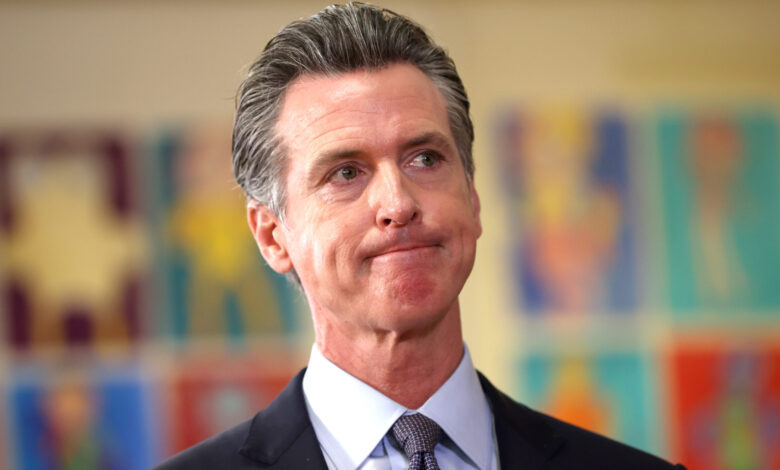
Then along comes Gavin Newsom.
Because apparently California’s favorite lawyered-up governor looked around the country, saw Democrats struggling to generate enthusiasm, and thought, I can fix this.
So Newsom traveled to Michigan to demonstrate that he still has some political juice.
The stated purpose was noble enough by Democratic standards: help Democrats retake power in Washington.
Newsom spent several days campaigning for Michigan Democrats, including newly minted Democratic Senate nominee Abdul El-Sayed. He also visited a black church, attended a barbecue and delivered a canvassing speech for state House Democrats. Newsom has made no secret of his interest in building a national political profile ahead of a potential 2028 presidential run.
And then came the awkward part.
According to reports, some of the people Newsom presumably wanted to impress weren’t exactly waiting at the airport with a marching band.
Virgie Rollins, chair of the Democratic National Committee’s Black Caucus, apparently didn’t meet with him despite an invitation from a liaison.
Rollins’ response was devastatingly simple.
Every Democratic president who has won an election, she said, has been in her house.
Newsom wasn’t.
“I did not hear from him. I did not get a call.”
That’s not exactly the political equivalent of throwing rose petals.
Then there was Rep. Debbie Dingell, a Michigan institution and one of the most recognizable Democratic political names in the state.
Did she meet with Newsom?
Nope.
Dingell told Politico she didn’t hear from him and didn’t expect to.
“I’m a car girl,” she said.
Translation: Governor, perhaps don’t come to Detroit and lecture the people whose livelihoods are tied to automobiles about how California thinks they should build automobiles.
And therein lies the larger Democratic problem.
Democrats have become a collection of contradictions wearing expensive campaign shirts.
Consider the scene.
Gavin Newsom, governor of California, arrives in Detroit, the spiritual home of the American automobile industry, to campaign for a progressive candidate.
Michigan is a state whose political identity is deeply connected to manufacturing, automobiles, internal-combustion engines and working-class voters.
And who is Newsom embracing?
Abdul El-Sayed, a candidate whose political profile is firmly on the progressive side of the Democratic Party.
The Democrats are trying to sell this as unity.
It looks more like a family reunion where everyone has been invited but nobody agrees on why they’re there.
And then there is Elon Musk.
For years, Democrats told Americans that electric vehicles represented the future. They celebrated technological disruption. They embraced Tesla as the embodiment of the green revolution. Musk was, for a time, practically the Democratic Party’s favorite eccentric billionaire.
Then Musk stopped behaving like the billionaire Democrats wanted him to be.
He supported Trump.
He criticized the administrative state.
He became an apostate.
And suddenly the man whose electric cars helped make the EV revolution commercially unavoidable became someone many Democrats openly despise.
You couldn’t write a better political satire.
The party that spent years telling Americans to buy the future is now furious at one of the men who helped build it.
This is what happens when ideology becomes more important than results.
Democrats aren’t simply losing arguments. They’re increasingly losing the ability to recognize what ordinary Americans actually find compelling.
They think because someone is famous on MSNBC, CNN, TikTok or Democratic Twitter, that person must have enormous political appeal.
But political fame is not the same thing as political popularity.
And this brings us to the question Democrats really don’t want to answer:
Can any Democrat actually draw a crowd?
Not a fundraiser filled with lobbyists.
Not a Hollywood event where someone gets comped six figures to perform.
Not a room packed with Democratic activists who have been promised free food and a photo opportunity.
I mean an actual crowd.
People who voluntarily show up because they want to see the candidate.
People who stand in the heat.
People who bring their kids.
People who cheer without being instructed by a campaign staffer.
People who don’t need Beyoncé to convince them that the candidate is worth seeing.
That particular trick seems to have lost some of its magic after the King Kamala era.
And Democrats are going to need more than celebrity surrogates to get through the midterms.
I have already made my prediction about what happens to Democrats in November, so I won’t beat that dead horse again.
Well…
Democrats keep insisting the horse is perfectly healthy, so apparently somebody has to keep checking its pulse.
The Democratic Party keeps telling America that a massive political comeback is underway.
Maybe.
But if that is true, somebody should probably tell the voters.
Because right now, the Democrats seem to have a strange problem.
Their politicians are everywhere. Their enthusiasm is nowhere.
Mark Kelly goes to Iowa and gets heckled.
Gavin Newsom goes to Michigan and discovers that some of the people who should be lining up to see him apparently didn’t even return the phone call.
Abdul El-Sayed wins a Democratic Senate primary and immediately becomes a national test of whether the party can stitch together its progressive and establishment factions. (The Guardian)
And Democrats are increasingly relying on the same ideological machinery that produced their current predicament.
They insist America is moving left.
They insist their unpopular candidates are secretly popular.
They insist their policies are mainstream.
They insist their coalition is bigger than it looks.
And then they walk outside.
That’s where the polling stops.
That’s where the consultants disappear.
That’s where the MSNBC graphics package can’t save you.
That’s where an Iowa fairgoer can simply yell something at you.
And that’s when a politician discovers the difference between being important to Democrats and being important to America.
The distinction is becoming harder for the Democratic Party to ignore.
Maybe that’s why the next few months are going to be so entertaining.
Democrats have spent years telling us how popular they are.
America may finally get the opportunity to answer:
“If you say so. Now show us the crowd.”