

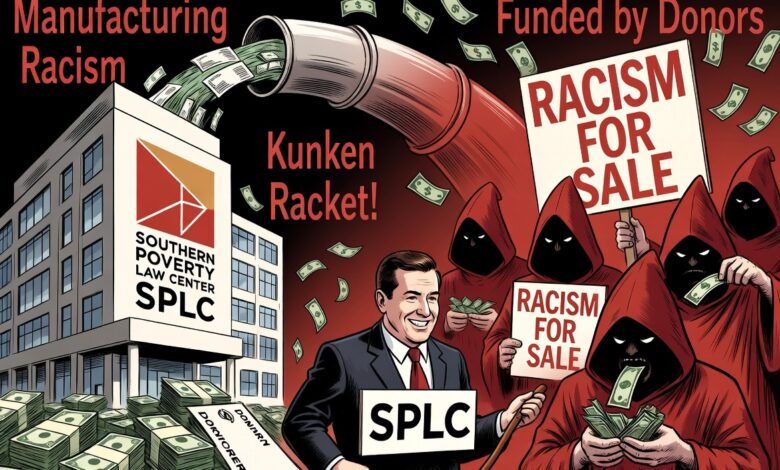
The cat isn’t just out of the bag. It’s knocking over lamps and looking for something to sinks its claws into.
Because what’s being exposed right now isn’t merely hypocrisy, nor is it a one-off scandal tied to a single organization. It is, unmistakably, a business model. And like most business models, it relies on one thing above all else: a consistent, renewable resource.
In this case, that resource is racism.
Not actual racism, mind you, which has been in measurable decline for decades, despite every attempt to keep it on life support. No, what we’re talking about is a curated, manufactured, endlessly expandable version of racism that can be scaled, branded, and, most importantly, monetized.
And at the center of that ecosystem sits the Southern Poverty Law Center, an organization that, for years, has been treated less like a watchdog and more like a theological authority on who qualifies as morally acceptable in modern America.
Now, with the Department of Justice reportedly taking a hard look, the reaction from the Left hasn’t been curiosity or introspection. It has been panic dressed up as outrage.
When the Defenders Sound Like Alarm Bells
Enter the NAACP, which responded to the unfolding situation with all the restraint of a fire alarm in a microwave factory.
“The DOJ’s indictment of the Southern Poverty Law Center is a chilling attack on civil rights advocacy. “Trump’s DOJ has been weaponized by dangerous forces. Every organization and individual engaged in social justice should be alarmed. What we are seeing in real time is an administration seeking to leverage its position to target individuals and organizations that do not agree with its political thought.” — NAACP President and CEO @DerrickNAACP
Stand with us. We’re urging every advocate to speak out and encouraging every voter to make their voices heard loud and clear in November during the midterm elections.”
Their statement hits every familiar note: “chilling attack,” “weaponized DOJ,” “dangerous forces.” It reads less like a measured defense and more like a prewritten script for crisis containment; as though the conclusion was determined long before the facts were even unpacked.
But the speed and intensity of that response reveal something deeper.
Because if your entire institutional framework depends on the credibility of a particular narrative, any challenge to that narrative doesn’t feel like scrutiny. It feels existential.
And that’s precisely what this is.
The Supply Problem Nobody Talks About
To understand how we got here, you have to rewind to a moment when the Left faced a quietly inconvenient reality: racism, as it had historically been defined, was fading.
Not gone. Not erased. But undeniably shrinking.
The election of Barack Obama was widely touted as a cultural milestone that might, at long last, close one of America’s most painful chapters. Instead, it marked the beginning of a strategic pivot.
Because if racism diminishes, so does the political leverage built upon it.
So the solution wasn’t to celebrate progress. Instead, they redefined the problem.
From Fringe to Everywhere: A Masterclass in Expansion
There was a time when “white supremacy” referred to specific, identifiable groups like the Ku Klux Klan or neo-Nazis. These were fringe elements, widely condemned, numerically insignificant, and socially isolated.
In other words, they were terrible… and rare.
Too rare, it turns out, to sustain a modern political movement that depends on urgency.
So the definition expanded. Gradually at first, then all at once.
Suddenly, “white supremacy” wasn’t just about explicit hatred or organized extremism. It became a catch-all term, elastic enough to stretch over anything from immigration policy to cultural preferences.
Borders? Suspicious.
Western traditions? Problematic.
Patriotism? Potentially dangerous.
And just like that, a supply shortage was transformed into a surplus.
It was economic alchemy. Take a scarce resource, redefine it, and flood the market.
Everyday Life, Now With Added Accusations
Once the definition ballooned, the applications became almost surreal.
Behaviors that once belonged to the realm of basic societal functioning were suddenly reframed as indicators of bias:
Showing up on time.
Speaking clearly.
Prioritizing logic in decision-making.
Even math, in certain academic corners, found itself on the defensive, as though arithmetic had secretly been harboring political ambitions all along.
And then there’s the American flag, a symbol that, for generations, represented unity, aspiration, and national identity.
Now, depending on who’s looking, it can trigger accusations that would’ve once been reserved for extremist iconography.
What’s particularly telling is the asymmetry.
Fly the American flag, and it’s scrutinized. Fly another nation’s flag, and it’s celebrated.
That’s not cultural sensitivity. That’s narrative management.
The Charlottesville Inflection Point
The Charlottesville rally 2017 served as a catalytic moment, not just politically, but economically.
In its aftermath, an entire industry began to crystallize around the concept of “defending democracy.” Organizations multiplied, funding streams expanded, and a new class of professional activists emerged, each positioned as essential to combating an ever-growing threat.
The scale of that growth wasn’t incidental.
It was structural.
Because once a narrative gains institutional backing, it doesn’t merely persist. It proliferates.
Tragedy, Money, and Momentum
Then came the death of George Floyd, an event that sparked nationwide protests and, just as significantly, an unprecedented wave of financial commitments.
Corporations pledged billions. Nonprofits saw historic surges in donations. Entire initiatives were launched, staffed, and branded within months.
Yet, despite the influx of resources, the underlying narrative didn’t shift toward resolution.
If anything, it intensified.
Because resolution, in this context, is counterproductive. And far less profitable.
The Nonprofit Paradox
Here’s the uncomfortable truth that sits at the heart of this entire ecosystem:
A nonprofit that successfully eliminates its core issue eliminates its own reason to exist.
It’s not a moral failing. It’s an incentive structure.
If homelessness disappears, so does the need for homelessness advocacy organizations. If systemic racism is eradicated, the institutions built to fight it must either evolve or dissolve.
And while evolution is risky, dissolution is unacceptable.
So the safer path is perpetuation.
Keep the problem visible, urgent, and just out of reach of a solution.
Donors and the Theater of Concern
It’s not just the organizations that benefit from this dynamic.
Donors, too, have a vested interest, whether consciously or not.
Because giving isn’t always about outcomes.
Sometimes it’s about participation.
Gala dinners. Board memberships. Public displays of alignment with socially approved causes.
There is a performative aspect to modern philanthropy that thrives on ongoing issues. A resolved problem doesn’t require a fundraiser. It doesn’t need awareness campaigns. It doesn’t justify annual events with keynote speakers and curated messaging.
It simply…ends.
And endings don’t generate revenue.
The Hidden Reports and the Unwelcome Data
Perhaps the most revealing detail in all of this is the allegation that reports showing a decline in white nationalist activity, alongside a rise in other forms of extremism, were downplayed or ignored.
Because data, when it contradicts the narrative, becomes inconvenient.
And inconvenient data doesn’t drive funding.
It doesn’t sustain urgency.
It doesn’t justify the scale of the existing infrastructure.
So it gets buried, reframed, or quietly set aside.
A System That Can’t Afford to Win
When you step back and look at the entire picture, a pattern emerges that is difficult to ignore.
This is not a system designed to solve problems, but designed to manage them.
To calibrate visibility, control perception, and ensure their continued relevance.
Because the moment the problem disappears, so does the system built around it.
And that is the real revelation here.
Racism has been exaggerated in certain contexts. And organizations have financial incentives. Worse however, it that an entire political and cultural apparatus has been constructed in such a way that success, in the traditional sense, is actually a threat.
The Business of Never-Ending Crisis
The exposure of the Southern Poverty Law Center isn’t just a scandal for one organization.
It’s a stress test for an entire ideology that has, over time, intertwined moral authority with financial dependency.
Because once people begin to question whether the problem is being solved or simply sustained, the conversation changes.
And when the conversation changes, so does the power dynamic.
The cat, as it turns out, wasn’t just hiding in the bag. It was part of the show all along.