

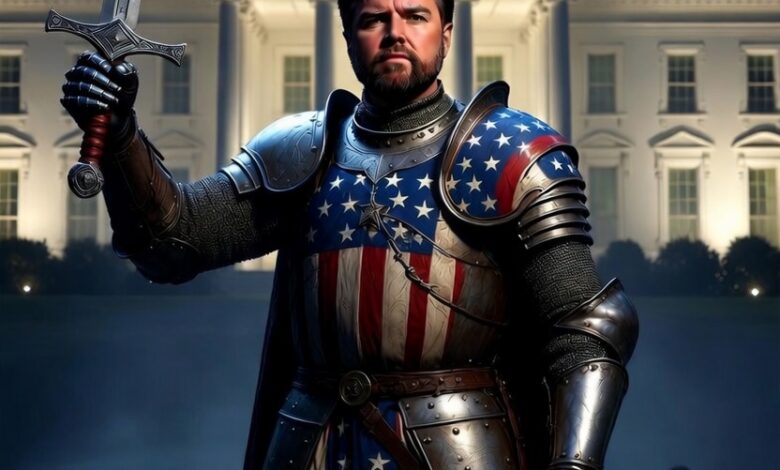
For months, the political spotlight has belonged to Marco Rubio.
The Secretary of State has been sprinting across the global stage like a man extinguishing geopolitical dumpster fires with a fire cannon on loan from God.
Foreign policy crises erupt every morning now with the reliability of Starbucks opening at 5 a.m., and Rubio has managed to stay in the center of nearly all of them.
China flexes. Iran threatens. Europe panics. Somebody somewhere launches something at someone else, and there’s Rubio on television again, looking like a guy who hasn’t slept since the Bush administration.
Meanwhile, JD Vance had largely faded into the political wallpaper.
Not gone. Not irrelevant. Just…waiting.
Washington is cruel to vice presidents.
The office has historically carried all the prestige of being the backup drummer in a legendary rock band. If the president succeeds, the VP gets polite applause. If the administration stumbles, suddenly everybody remembers the vice president exists. It’s why men like Dan Quayle became cultural punchlines instead of political heavyweights. America remembers vice presidents the way people remember the side salad that came with the steak.
And JD Vance knows this.
He understands that in modern politics, invisibility is death wrapped in a necktie.
So when President Donald Trump handed him oversight of major fraud investigations, Vance didn’t treat it like ceremonial busywork. He treated it like a launch sequence.
Because this assignment is not small.
This is not “chair a committee studying paperclips” territory. Trump effectively handed Vance a political flamethrower and pointed him toward some of the bluest states in America, where public money has allegedly vanished with the magical elegance of socks in a hotel dryer.
And Vance appears eager to pull on every thread.
The opening battlefield? Minnesota.
Which honestly makes perfect sense. Minnesota has quietly become one of the most fascinating contradictions in modern American politics. It presents itself as the land of clean governance, sensible moderation, and aggressively cheerful public radio voices that sound like they apologize to furniture after bumping into it. Yet beneath that wholesome Scandinavian frosting sits a government apparatus repeatedly rocked by fraud scandals large enough to make casino accountants blush.
Vance recently announced major indictments tied to fraud schemes in the state and posted this on X:
Today, the task force and the DOJ announced a massive take down of two of the largest Medicaid fraud cases in Minnesota state history, as well as the largest autism fraud scheme ever charged by the federal government. Our message is simple: if you’re committing fraud, we will… pic.twitter.com/MNfkLlOY0R
— JD Vance (@JDVance) May 22, 2026
“Today, the task force and the DOJ announced a massive take down of two of the largest Medicaid fraud cases in Minnesota state history, as well as the largest autism fraud scheme ever charged by the federal government.”
That’s not minor-league corruption. That’s industrial-grade looting.
And Democrats suddenly look nervous in the way cats look nervous when someone casually says the word “bath.”
The reason is obvious.
Fraud investigations create political shrapnel.
Unlike ideological arguments, fraud cases don’t stay neatly confined to policy debates. Fraud investigations lead to emails. Bank records. Contracts. Shell organizations. Donors. Family members. Consultants. Conveniently deleted text messages. They create connective tissue.
One indictment becomes three. Three become ten. Eventually, somebody flips faster than a pancake at IHOP.
That’s why this project matters politically far beyond Minnesota.
If Vance successfully turns anti-fraud enforcement into a nationwide crusade, he’s no longer “the vice president.” He becomes the face of accountability inside an administration already running on the argument that entrenched institutions are corrupt beyond repair.
That is rocket fuel for 2028.
Today, the task force and the DOJ announced a massive take down of two of the largest Medicaid fraud cases in Minnesota state history, as well as the largest autism fraud scheme ever charged by the federal government. Our message is simple: if you’re committing fraud, we will… pic.twitter.com/MNfkLlOY0R
— JD Vance (@JDVance) May 22, 2026
Especially because Americans already suspect massive systemic fraud exists. Most people don’t trust government bookkeeping any more than they trust gas station sushi. Years of COVID spending chaos, nonprofit scandals, NGO laundering allegations, and mysteriously disappearing taxpayer dollars have created a bipartisan exhaustion with institutional incompetence. The average American sees headlines involving hundreds of millions stolen and reacts with the emotional intensity of hearing somebody forgot ketchup at the drive-thru.
“Yeah, sounds about right.”
The public has become numb to corruption because the numbers are now absurd. We’ve entered the era where a billion dollars disappears and Washington reacts like somebody misplaced a stapler.
That’s where Vance may have found his lane.
Not foreign policy or culture war theatrics. Not cable-news gladiator combat.
Fraud.
Follow the money, and suddenly politics becomes less philosophical and more forensic.
Which brings us to Ilhan Omar.
Omar has long carried herself with the kind of swagger usually reserved for people who believe consequences are things that happen to other humans. Asked about possible investigations, she reportedly responded with her trademark confidence:
“If they want to indict me, let’s see what they’ve got.”
Ilhan Omar on allegations that she committed immigration fraud: “These people are disgusting. They’re racist. They’re xenophobic. They’re disgusting, bigoted people.” pic.twitter.com/2kM6DaOr8K
— TheBlaze (@theblaze) May 21, 2026
That line landed with the same energy as a movie villain announcing, “You’ll never catch me!” five minutes before the FBI kicks in the skylight.
Now, to be clear, public bravado is common in politics. Everybody acts tough. Democrats do it. Republicans do it. Washington is basically professional wrestling performed by people with law degrees. But Omar’s tone felt less like confidence and more like someone trying to whistle while walking past a graveyard.
Because the atmosphere has changed.
The Trump administration entering its second act is not operating with the same restraint of its first term. Personnel choices are sharper. Institutional battles are more targeted. The administration now understands where resistance comes from, how bureaucracies shield themselves, and which political pressure points generate the most fear.
And fraud investigations terrify political machines because fraud often exposes ideology as camouflage for opportunism.
That’s the hidden danger for Democrats here.
Every political movement has grifters attached to it, but progressive politics created an ecosystem uniquely vulnerable to fraud because it wrapped massive public spending inside emotional blackmail. Programs were sold not merely as government initiatives but as moral obligations. Ask questions, and you’re heartless. Demand oversight, and you’re racist. Audit expenditures, and suddenly somebody claims democracy itself is under attack.
That rhetorical shield worked beautifully for years.
Until the money started evaporating.
Minnesota alone has seen repeated scandals involving taxpayer-funded programs allegedly exploited by organized networks. The infamous Feeding Our Future scandal already damaged the state’s reputation nationally, with prosecutors alleging that hundreds of millions intended for child nutrition programs were siphoned away through fraud schemes.
Once voters see enough of these stories, a pattern emerges.
The progressive governance model increasingly resembles a neighborhood lemonade stand where somehow the cash box keeps disappearing, yet management insists the real problem is insufficient compassion.
And Vance appears ready to weaponize that perception nationally.
Not with philosophical speeches. With indictments.
That distinction matters.
Because Americans may tune out lectures about ideology, but they understand theft instantly. Fraud cuts through partisan static with surgical precision. A struggling family paying taxes while politically connected operators allegedly enrich themselves through public programs is not an abstract policy debate. It’s personal.
Which is why Democrats may find this issue uniquely difficult to counterattack.
Calling fraud investigations “politically motivated” only works until the handcuffs appear.
And if Vance expands these investigations into battleground states, the implications become enormous. Wisconsin. Michigan. Pennsylvania. Arizona. Georgia. Every state where progressive nonprofit networks intersect with government money suddenly becomes fertile ground for scrutiny.
That’s not merely law enforcement.
That’s political trench warfare.
Which explains why Vance suddenly feels more visible than he has in months.
Rubio may still command the international spotlight, navigating wars and diplomatic crises like a caffeinated air-traffic controller, but Vance has potentially found something even more politically valuable: a domestic mission voters can emotionally understand.
Foreign policy earns respect.
Exposing corruption earns fury.
And fury moves elections.
Especially when Americans already suspect the game has been rigged for years.
If Vance succeeds, he won’t just avoid becoming another forgettable vice president trapped in ceremonial limbo. He’ll become the Republican who turned fraud investigations into a national movement. The guy who walked into bureaucratic dark corners with a flashlight while half the political establishment suddenly developed a nervous twitch.
That possibility should terrify Democrats.
Because scandals age badly, but patterns age worse.