

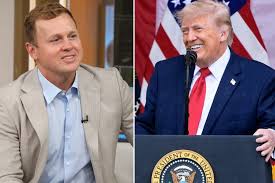
Most losing candidates disappear.
They thank their supporters, blame a few consultants, make promises about the future, and eventually become a trivia question.
Spencer Pratt appears to have chosen a different path.
By losing.
Los Angeles politics has always resembled a magic show performed by people who misplaced the rabbit. Ballots appear. Ballots disappear. Counts take days, weeks, sometimes long enough for a child to begin kindergarten and graduate before the final totals arrive.
Californians have grown accustomed to it.
What they weren’t accustomed to was watching Democrats react to it.
When Congressman Ro Khanna revealed that a close friend had become so frustrated with the vote-counting process that he reportedly removed himself from the voter rolls, the statement landed like a bowling ball dropped into a swimming pool.
Khanna likely intended the story as a cautionary tale about voter frustration.
Instead, he may have revealed something far more significant.
His friend reportedly believes Spencer Pratt was robbed.
Pause there.
For years Americans were told that election skepticism belonged exclusively to Republicans. Questioning elections was supposedly a uniquely MAGA condition. The diagnosis arrived before the examination. Ask a question, receive a label.
Yet here was a Democrat expressing precisely the type of concern his party spent years condemning.
Somewhere, irony applied for overtime pay.
What makes the episode particularly fascinating is that it doesn’t exist in isolation.
Political parties rarely collapse all at once. They lose credibility the way a tire loses air. At first the leak is barely noticeable. Eventually people begin wondering why the ride feels so rough.
During the Biden years, Democrats reportedly watched millions of voters abandon the party. Some became Republicans. Others became independents. Many simply stopped believing what they were being told.
Those departures weren’t driven by a single issue.
Inflation played a role, as did immigration. Crime played a role.
The growing gap between official narratives and observable reality certainly played a role.
Every time Americans were told not to believe their own eyes, another little puff of air escaped the tire.
Then came voices nobody expected.
Jillian Michaels recently discussed her changing views regarding election issues and the integrity of voting systems.
Are California’s Elections “Rigged”?! Here’s the TRUTH behind California’s “slow count,” why the numbers flipped, and what comes next in the showdown between Trump and Newsom.
Watch the full episode on my YT channel! Link is in the comments ⬇️ pic.twitter.com/0gkoBNC5jC— Jillian Michaels (@JillianMichaels) June 10, 2026
That matters.
Not because Michaels is an election expert.
Celebrity opinions generally possess the intellectual rigor of fortune cookies.
What matters is that she represents something larger.
When people who once dismissed concerns begin expressing concerns of their own, a political movement should pay attention.
Political history is filled with these moments.
The Soviet Union did not wake up one morning and discover nobody believed the government.
Trust eroded gradually.
The press didn’t lose credibility in a weekend. Years of contradictions accomplished that task.
Public confidence disappears one disappointment at a time until suddenly everybody notices it’s gone.
Democrats may be approaching a similar crossroads.
ActBlue has generated questions. And the answers won’t be good for Democrats.
Further, election administration continues generating questions.
Vote-counting delays continue generating questions.
The response from Democrats often seems remarkably consistent.
Stop asking questions.
Unfortunately for them, that strategy works only until their own voters start asking.
Ro Khanna’s friend represents a problem because he breaks the narrative.
Democrats have spent years portraying election skepticism as a Republican phenomenon.
What happens when the skeptics start carrying Democratic voter registration cards?
What happens when former allies begin sounding like former opponents?
What happens when Californians begin looking at local elections and drawing uncomfortable parallels to larger national debates?
Those questions are far more dangerous than Spencer Pratt himself.
A victorious Spencer Pratt would have become a mayoral candidate.
A defeated Spencer Pratt may have become something far more useful.
Evidence.
His campaign provided a real-world test of public confidence in election outcomes.
The results suggest confidence is eroding in places Democrats once considered politically immune.
That should concern anyone who cares about elections.
Trust cannot be demanded.
It cannot be fact-checked into existence.
It cannot be manufactured through press releases.
People either believe a system is transparent and trustworthy or they don’t.
Once doubt escapes its political containment zone, it tends to travel.
Today it appears in Los Angeles. Tomorrow it appears somewhere else.
Which brings us back to Spencer Pratt.
He lost the election.
Yet his supporters aren’t the story.
Ro Khanna’s friend is.
Jillian Michaels is.
The millions of voters who walked away from Democrats are.
Because Spencer Pratt may have accomplished something few losing candidates ever achieve.
He forced Democrats to confront the possibility that election skepticism is no longer a Republican issue.
And if that realization continues spreading through California, Pratt’s most important political victory may have arrived the day he “lost”.