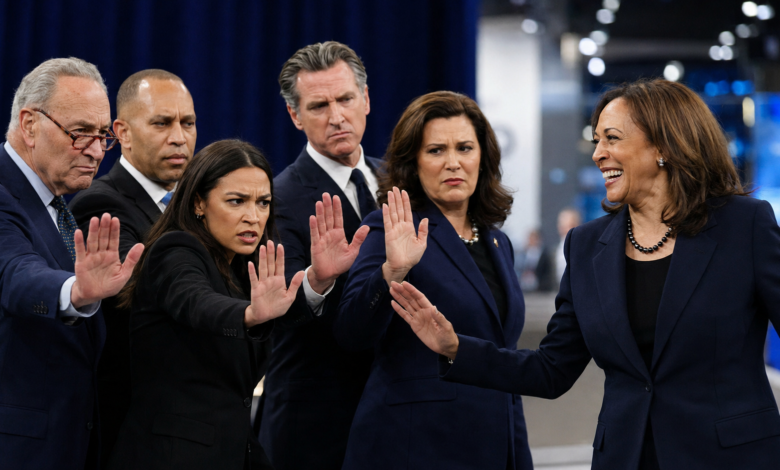
Kamala Harris has finally found a job she may be qualified to perform for the Democratic Party: staying home.
That is not Republican spin. It is the practical request coming from Democrats who would like to remain employable after November.
According to Politico’s reporting, leading Democratic candidates in Iowa do not want Harris campaigning for them. Alaska’s Democratic Senate nominee rejected a fundraising solicitation Harris sent on her behalf. Democrats running in Wisconsin and Kansas reportedly prefer that the former vice president admire their campaigns from a safe distance—preferably one measured in time zones.
Imagine achieving such historic status within your own party that your most valuable contribution is an alibi proving you were nowhere near the candidate.
Peter Alexander confronted Harris with the report during an interview on MS NOW’s State of Play. Her answer deserves preservation, because no Republican operative could have written a cleaner confession.
“These candidates know what they need to do to win,” Harris said, adding, “I support them in doing whatever they need to do to win.” Her complete response and the surrounding exchange can be viewed in Mediaite’s report and video.
Translation: if Democrats believe the shortest route to victory involves keeping Kamala Harris away from microphones, airplanes, fundraisers, and recognizable zip codes, she respects their judgment.
This may be the most lucid position Harris has ever taken.
The endorsement nobody wants
Political parties ordinarily deploy former presidents and vice presidents as validators. They raise money, energize volunteers, dominate local media, and reassure voters that the candidate belongs to a successful national coalition.
Harris offers a slightly different service. She helps Democratic candidates demonstrate their independence by publicly refusing her help.
She has become a reverse surrogate. Her absence is the endorsement.
The humiliation is bigger than a few declined campaign appearances. Democratic leaders and their media department spent years telling Americans that Harris was brilliant, historic, formidable, and uniquely prepared. Voters were instructed to disregard the word salads, the nervous laughter, the staff churn, and the absence of any convincing evidence that she could carry a national ticket.
Then the country rendered its verdict in 2024. Harris lost the Electoral College, the popular vote, and every battleground state. Democrats could have studied that rejection. Instead, many treated it like a customer-service complaint: perhaps America simply did not understand the product.
Now their own candidates understand it perfectly.
Rob Sand, the Democratic nominee for governor in Iowa, has said he does not want Harris—or Joe Biden—campaigning for him and answered “Nope” when asked whether Harris should run for president again, according to The Guardian’s account of his Politico interview. That is not subtle distancing. That is a political restraining order with lawn signs.
Democrats recognize the damage but not the disease
These Democrats want distance from Harris, but not necessarily from what Harris represents. They want voters to believe they are independent while continuing to belong to the party that installed her, protected her, nominated her, and spent years demanding that Americans pretend her limitations were assets.
They are not rejecting the restaurant. They merely want the most famous case of food poisoning removed from the menu.
Harris used her answer to accuse the Trump administration of lawlessness and promised Democrats would deliver lower costs, affordable health care, and affordable child care. Notice the ritual. Faced with evidence that members of her own party regard her as an electoral liability, she immediately returned to the same Democratic brochure language voters have heard for years.
Lower costs? This is the party that defended the Biden-Harris economy while Americans watched groceries, housing, energy, and insurance consume larger portions of their paychecks. “Affordable” has become the word Democrats attach to things immediately before government makes them more expensive.
The formula never changes: deny the record, rename the failure, accuse Trump, and promise to repair the conditions your party helped create.
That is not a campaign platform. It is a psychological loop.
Kamala 2028: the sequel nobody ordered
Alexander also asked Harris whether she planned to campaign for herself as a presidential candidate in 2028.
She replied that 2028 “doesn’t matter” if Democrats do not win in 2026.
On this narrow point, Harris is correct. Before Democrats can market Kamala 2: The Cackle Strikes Back, they need candidates capable of surviving the trailer.
Her continued presidential viability reveals the deeper problem. Harris can be too dangerous for a Democratic candidate in Iowa, Alaska, Wisconsin, or Kansas, yet remain plausible presidential material inside the national party. The person Democrats do not want standing beside them may soon ask the entire party to stand behind her.
That contradiction is not merely funny. It explains modern Leftism.
Failure does not disqualify its leaders. It elevates them. Bad ideas are not discarded; they are rebranded. Electoral rejection is never a verdict on the ideology. It is blamed on messaging, misinformation, prejudice, insufficient enthusiasm, or voters who allegedly failed to appreciate what was being done to them.
Democrats spent years telling America that Kamala Harris was indispensable. Their candidates now hope she will prove it—by disappearing.