

Democrats Never Age Out of Corruption
By Kevin Jackson
The Louise Lucas indictment raises a familiar question: When politicians promise to care for the public, why does the alleged business plan keep starting with taking care of themselves?
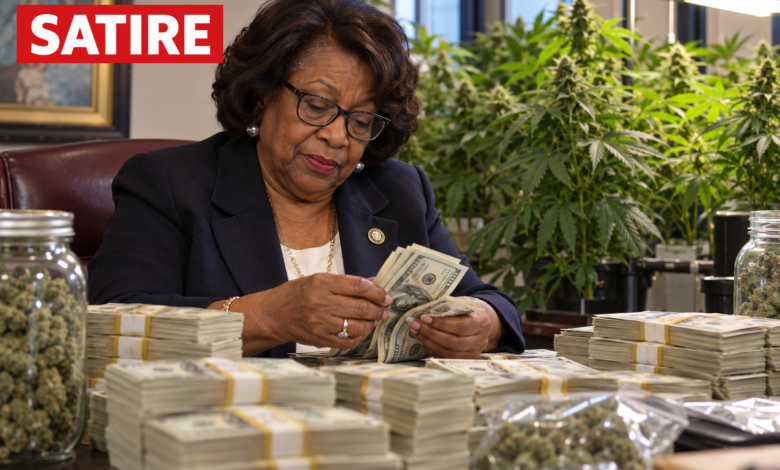
At 82, most grandmothers want you to leave their house with leftovers. According to federal prosecutors, Virginia Democrat Louise Lucas had considerably more ambitious distribution plans.
Apparently, Democrats never age out of corruption. They just reach the point where the alleged criminal enterprise qualifies for the senior discount.
Lucas, one of Virginia’s most powerful legislators, now faces federal charges involving an alleged marijuana enterprise. Prosecutors accuse her of using public office to protect private interests, with family members participating in the operation. She is presumed innocent, and the government must prove its case. But the allegations deserve considerably more attention than another politician assuring us how deeply she cares.
Because that word—care—has become the most generous expense account in American politics. Politicians care about your health, your children, your neighborhood, your economic opportunities. They care so much that somehow they must remain in office for decades, supervising problems that refuse to improve while their access and influence appreciate beautifully.
Then federal investigators arrive, and suddenly everybody would appreciate a little privacy.
According to reporting on the indictment, an intermediary delivered Lucas $100,000 supplied by the FBI. The transaction involved repayment of an earlier investment, and prosecutors allege she connected payment with assistance involving marijuana licensing. That distinction matters: Recovering an investment is one thing; trading official assistance for money is another. The alleged connection is what prosecutors must establish.
Still, you have to appreciate the setting. A public official. A regulated industry. A substantial financial interest. Government permission that could make that interest more valuable.
What a coincidence that the person with money at stake also had a hand near the machinery.
Ordinary entrepreneurs worry about whether their businesses can survive the rules. Politically connected entrepreneurs introduce an intriguing additional question: Who gets to help write them?
That is where this story becomes bigger than a cannabis shop.
You can favor marijuana legalization and still object to legislators allegedly converting their authority into a commercial advantage. You can oppose legalization and recognize the same problem. The public debate concerns what rules should govern everybody. The corruption question concerns whether somebody entrusted with writing those rules has reserved a private entrance.
Prosecutors allege Lucas used her position to shield the enterprise from scrutiny and influence legislation for its benefit. Those remain allegations. If proven, however, they would describe something far more serious than a politician making an unfortunate investment. They would describe public authority being used as business equipment.
And that is my larger objection to the Democratic promise of ever-expanding government. Every additional permission government controls creates another opportunity for somebody to sell access to the person granting it.
They tell you the system needs more oversight. Fine. Who oversees the person selling the oversight?
They tell you a market needs careful regulation. Perhaps it does. But regulation becomes a peculiar public service when the regulator allegedly has a financial reason to steer it.
At that point, the citizen isn’t being protected. He is competing against somebody who brought the referee to the game.
Lucas belongs on the growing list of powerful Democrats whose conduct requires scrutiny rather than automatic deference. Her case is pending. Other entries on that list have already passed through a jury.
Consider former Democratic Senator Bob Menendez. In January 2025, he was sentenced to 11 years in prison following convictions involving bribery, foreign-agent conduct and obstruction. Investigators found cash and gold bars in his home.
Gold bars.
Most Americans open a retirement account. Menendez apparently preferred the monetary arrangements of a recently overthrown monarchy.
Then there is Michael Madigan, the longtime Democratic power broker in Illinois. At 83, he received a seven-and-a-half-year prison sentence in June 2025 following his corruption conviction. The case included payments to his associates for little or no legitimate work, intended to influence and reward him over legislation.
Eighty-three years old, and still finding employment opportunities for people who didn’t necessarily need to perform employment.
There goes the argument that all we need is more experience in government.
Experience doing what?
Longevity can produce wisdom. It can also produce a politician who knows every weak point in the system, every useful intermediary and precisely which favor requires a conversation away from the microphone. We should stop treating years in office as evidence of good character. Sometimes they simply establish how long somebody has controlled the room.
Republicans who betray the public belong in court, too. My objection is to a Democratic political culture that campaigns as though compassion comes with the party registration, then acts offended when voters ask to inspect the merchandise.
Which brings us to drugs—and the extraordinary flexibility of political concern.
When politicians discuss drug policy, we hear about public health, equity, opportunity and protecting vulnerable communities. Those are serious subjects. But the seriousness of the vocabulary does not establish the sincerity of the speaker.
A politician’s financial interest ought to make us ask harder questions, especially when that politician can influence the conditions under which the business operates.
Are drugs dangerous? Are safeguards necessary? Who should receive a license? What enforcement is appropriate?
Those questions deserve answers based on public welfare. They should never depend on whose investment needs rescuing.
Lucas’s case concerns marijuana, not fentanyl. The broader political question is how officials measure their supposed concern for people affected by drugs—and whether concern survives contact with personal profit.
Look at the suffering associated with fentanyl in cities governed for years by Democrats. San Francisco’s own medical examiner publishes continuing reports documenting accidental overdose deaths and the drugs involved. These are actual deaths requiring official accounting, not an inconvenient collection of conservative talking points.
People bent over on sidewalks, families searching for missing children, merchants trying to keep a doorway usable: none of them should have to compete with a politician’s preferred description of the situation.
And when overdose deaths fall, good. Save the next person. Expand what works. But improvement should strengthen accountability, not become an excuse to forget how much suffering was tolerated.
Somehow, demanding usable streets gets treated as a failure of empathy. Parents are expected to explain the public drug scene to their children while officials explain why the parents’ language needs improvement.
A man can be visibly losing his life in front of you, and the political argument becomes whether you described the scene sensitively enough.
I care considerably more about whether he survives it.
The person struggling with addiction deserves a way out. His family deserves help. The neighborhood deserves safety. Those goals belong together. A government that forces people to choose among them has failed at something fundamental.
Yet the Democratic brand asks us to judge compassion primarily by declarations. We care because we said we care. The policy failed? We need more resources. Residents object? They need more understanding. Somebody asks where the money went? Apparently, that person lacks compassion, too.
It is an impressive arrangement. The public supplies the money, experiences the consequences and then gets lectured about its attitude.
Now put that beside allegations that a powerful politician used her office to benefit a drug business. The contrast is precisely why the Lucas case matters. Public welfare demands vigilance, discipline and impartial rules. Private enrichment demands something much simpler: a favorable outcome for the person collecting.
A public official cannot credibly ask citizens to trust her judgment while treating questions about her financial interests as an insult.
Trust requires inspection.
That applies to licensing, contracting, education, housing, health care and every other area politicians assure us they are uniquely qualified to manage. There is no category of human need so noble that it cannot attract somebody looking for a percentage.
In fact, noble causes provide excellent cover. Ask a question about the arrangement, and somebody immediately points to the deserving people the arrangement supposedly serves.
We’re helping the children.
We’re protecting the vulnerable.
We’re expanding opportunity.
Wonderful. Open the books.
Compassion should survive an audit.
Lucas will have her opportunity to contest the government’s case. She should. The distinction between an allegation and a conviction matters, even when the defendant belongs to a party whose lectures have exhausted my patience.
But voters need not suspend their judgment about the larger problem while lawyers prepare for trial. Decades of service do not entitle politicians to unquestioning trust. Powerful committee assignments should invite scrutiny. Financial interests in industries affected by their decisions should invite more.
And “I care about my constituents” should never function as an answer to “What did you receive?”
The lesson from Menendez and Madigan is already established. The allegations against Lucas present another test. Age does not automatically soften greed. Power does not automatically produce responsibility. And a politician can spend a lifetime discussing public service without ever developing an appetite for leaving it.
Democrats keep asking Americans to trust how much they care.
I suggest we start checking who gets paid.