

There’s a peculiar sound echoing through the marbled hallways of Washington these days.
It isn’t the usual hum of lobbyists trading favors like baseball cards, nor the polite applause of politicians congratulating themselves for naming another post office. No, this sound is sharper. Faster. It’s the unmistakable shuffle of expensive shoes heading for the exits.
Sixty-six members of Congress have announced they will not seek re-election in 2026.
That’s not a trickle. That’s not even a steady stream. That’s a political fire drill where half the building already knows which door to use.
And if you listen closely, beneath the official statements about “spending more time with family” or “pursuing new opportunities,” you can almost hear the unspoken translation: Something’s coming.
Let’s not pretend this is normal.
At this point in previous election cycles, retirement numbers hovered in the 30s and 40s. Manageable. Predictable. The kind of political churn that keeps consultants employed and cable news panels caffeinated. But 66? That’s not churn. That’s a controlled demolition with a press release.
Now, the professional spin class in Washington will tell you this is just “natural turnover.” Of course it is. And hurricanes are just enthusiastic breezes.
Because when you dig into the details, the story starts to look less like routine and more like retreat.
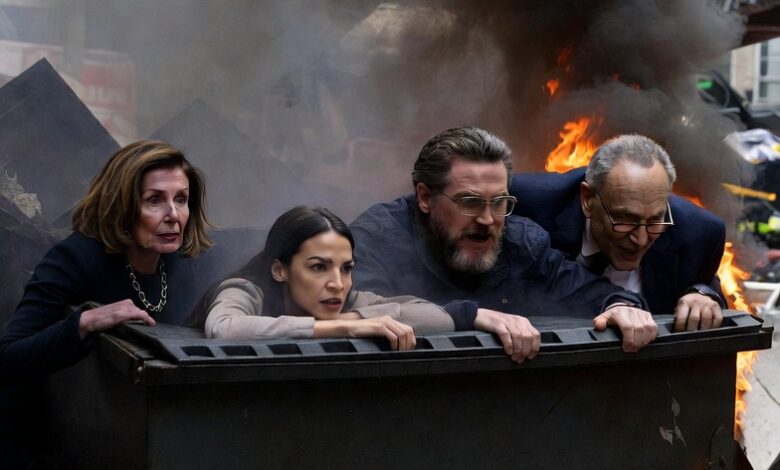
Fifty-six House members are stepping aside. That includes 21 Democrats and 35 Republicans. Of those, nearly half are flat-out retiring from public life, while others are scrambling for political lifeboats—Senate runs, gubernatorial bids, even a shot at state attorney general. It’s as if Congress suddenly became a burning building and everyone’s checking LinkedIn at the same time.
Several of these departing Republicans, such as Ryan Zinke, Steve Daines, Burgess Owens, and Tony Gonzales, are leaving behind seats rated as solid or safe for the GOP. In political terms, that’s like owning beachfront property and deciding to move inland just before hurricane season.
Even more curious is Darrell Issa’s departure from a district rated as a toss-up or leaning Democrat. That’s not a retirement; that’s a calculated exit from a battlefield that’s about to get very loud.
So what’s driving this exodus?
You don’t need a decoder ring. You just need pattern recognition.
For years, Americans have been told that Washington is an immovable object. A permanent class of insiders who glide from election to election, insulated from consequences, wrapped in the protective bubble of media narratives and procedural fog. But something has disrupted that ecosystem.
Enter Donald Trump.
Love him or hate him—though let’s be honest, those categories are rarely balanced—Trump didn’t just challenge the system. He exposed it. Like pulling back a curtain and discovering the wizard is less “all-powerful” and more “middle manager with a smoke machine.”
His first term introduced a concept that Washington had long forgotten: accountability with teeth.
And now, in 2026, the aftershocks are still rolling.
Because here’s the uncomfortable truth for the political class: Trump didn’t just build a movement. He rewired expectations.
Voters who once tolerated political theater now demand results. Constituents who were content with carefully worded statements now want action that survives daylight. And perhaps most terrifying of all for career politicians, the public has developed a taste for disruption.
That’s not something you can poll your way out of.
So when you see dozens of lawmakers stepping aside—many from seemingly safe positions—you have to ask the question Washington refuses to say out loud: What do they know?
Is it the shifting electorate? Almost certainly.
Is it the growing unpopularity of Democrat policies, which increasingly resemble a patchwork of ideological experiments stitched together without regard for real-world consequences? That’s part of it.
But there’s another layer here. A deeper one.
Fear.
Not the theatrical kind politicians use during campaign season, where every election is “the most important of our lifetime.” No, this is the quiet, calculating fear of exposure. The kind that makes you reconsider your career choices at 2 a.m.
Because if Trump’s second act delivers even a fraction of what his supporters expect—namely, a serious dismantling of entrenched bureaucratic power—then the rules of the game change dramatically.
And when the rules change, the players who benefited from the old system suddenly look… vulnerable.
Democrats, of course, are putting on a brave face. Publicly, they speak with confidence about the midterms, projecting optimism with the enthusiasm of a gambler on a losing streak insisting the next hand will turn everything around.
Privately? That’s another story.
Because the numbers don’t lie, even when politicians try to.
Policy failures, economic frustration, cultural overreach—these aren’t abstract concepts. They show up in grocery bills, school board meetings, and crime statistics. They shape voter sentiment in ways no messaging strategy can fully contain.
And while Democrats may hope to reclaim the House or hold the Senate, the underlying currents suggest a different trajectory. One where their coalition is less stable than advertised, and their message resonates less with a public that’s grown increasingly skeptical.
Meanwhile, the Republican side, buoyed by the enduring influence of Trump, is not just campaigning. It’s consolidating.
The MAGA movement, once dismissed as a passing wave, has proven to be more like a tide—persistent, reshaping the shoreline over time. And as it gains strength, it forces a choice upon those within the party: adapt or step aside.
Many, it seems, are choosing the latter.
“Out with the old and in with MAGA” isn’t just a slogan. It’s a transition. A generational shift that’s redefining what it means to be a Republican in the modern era.
And here’s where things take on an almost theatrical quality.
Because while one side prepares for what it believes will be a resurgence, the other appears to be bracing for impact.
The idea that Democrats could face significant losses in the midterms isn’t new. But the scale of potential change—combined with the unusual number of retirements—suggests something more profound than a typical electoral swing.
It hints at a recalibration of power.
Election integrity has become one of the most contentious issues in American politics, with debates raging over everything from voting procedures to ballot security. For many conservatives, the belief is clear: reforms are necessary to restore confidence in the system.
And if those reforms materialize in a meaningful way, the political landscape could shift dramatically.
The “cheating establishment,” as critics often call it, thrives in ambiguity. It operates best when scrutiny is low and accountability is diffused. But introduce transparency—real, enforceable transparency—and suddenly the calculus changes.
Because the risk-reward equation flips.
What was once seen as a manageable gamble becomes a potential liability with serious consequences.
And that’s where the predictions come into play.
I content that by mid-2026 Democrats will have a clearer understanding of their dire electoral fate. High-profile developments—whether they take the form of investigations, legal actions, or broader systemic changes—could accelerate that process.
And if the appetite for risk diminishes, so too does the willingness to engage in behavior that could lead to severe repercussions.
In simpler terms: when the cost of getting caught outweighs the benefit of winning, people reconsider their options.
Which brings us back to those 66 members of Congress.
Their departures may be framed as personal decisions, but collectively, they tell a story. A story of a political environment in flux, where old assumptions no longer hold and new realities are taking shape.
It’s a story of a system that, for all its resilience, is not immune to pressure.
And it’s a story that’s still unfolding.
Because if this is what the prelude looks like—if this is the quiet before the storm—then the main event promises to be anything but subtle.
Washington, after all, is a city built on anticipation.
And right now, anticipation feels a lot like evacuation.