210There was a time when the Pope felt like a figure carved from marble and mystery, a man whose words hovered above the daily mud-wrestling of politics. He wasn’t in the trenches throwing elbows with presidents and pundits. He stood apart, like a lighthouse keeper who didn’t argue with the waves but simply warned ships where the rocks were.
Somewhere along the line, that lighthouse started hosting press conferences about maritime policy.
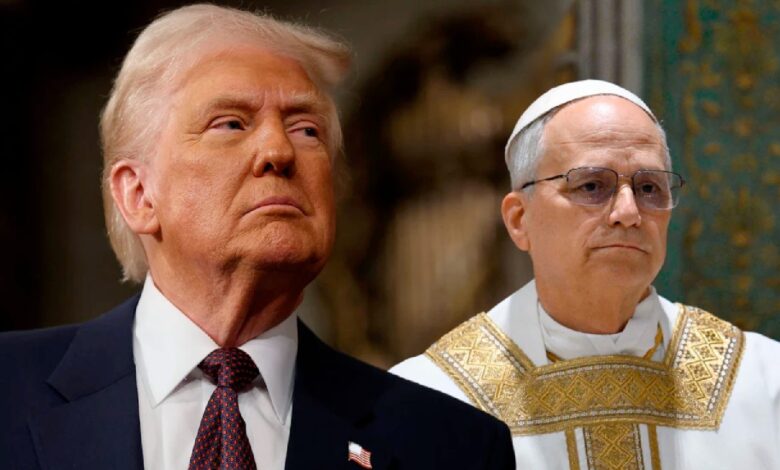
And that shift, subtle at first and now unmistakable, is what makes recent comments from the Vatican feel less like timeless guidance and more like a well-timed guest appearance on a very partisan stage. Because when a Pope declares, “Woe to those who manipulate religion and the very name of God for their own military, economic, and political gain,” it lands with the weight of scripture… until you notice who it seems aimed at, and perhaps more importantly, who it’s not.
That’s when the statement sounds more like talking points than a sermon.
To be clear, moral warnings are part of the pope’s job description. Nobody expects a Pope to shrug at the misuse of faith. But context matters, and consistency matters more. When a global religious authority appears to selectively apply outrage, people notice. They may not all say it out loud, but they feel it, like a piano note just slightly out of tune.
And right now, that note is ringing.
Because if we’re going to start handing out “woes,” then history politely raises its hand and says, “You might want to go first.”
The Catholic Church is not exactly new to the intersection of faith and power. This is an institution that didn’t just influence kings; it crowned them. There were moments when the line between church and state wasn’t blurred, it was practically erased with a flourish of ceremony and a very ornate hat.
That doesn’t invalidate the Church’s spiritual mission, but it does make the sudden alarm over religion in politics feel… curated.
And then there’s the more recent history, the kind that hasn’t yet faded into dusty textbooks.
Decades of abuse scandals didn’t just dent the Church’s credibility; they carved out a crater. Over $4 billion in settlements in the United States alone is not a footnote. It’s a flashing neon sign that says, “Handle moral authority with care.”
Which raises a simple, unavoidable question: when an institution is still rebuilding trust after such profound failures, is the wisest move to step deeper into political discourse and start issuing global critiques?
Or, as some might see it, is that less of a calling and more of a pivot?
Because what we’re witnessing doesn’t feel like random commentary. It feels targeted. The themes are familiar, the framing is recognizable, and the timing, well, the timing is almost too convenient. When rhetoric from the Vatican begins to mirror the language of one side of the political spectrum, even unintentionally, it invites scrutiny.
Not because people are looking to be cynical, but because patterns have a way of revealing themselves.
Take immigration, for instance, a topic that seems to draw particularly passionate responses. The messaging from the Vatican leans heavily toward compassion, openness, and moral obligation. Those are noble principles, no question. But policy is where principles meet reality, and reality has a habit of complicating even the most well-intentioned ideas.
Communities on the ground aren’t dealing in abstractions. They’re navigating strained resources, public safety concerns, and the kind of ripple effects that don’t fit neatly into a homily. When tragedies occur, when lives are lost, those aren’t theoretical debates. They’re permanent consequences.
Yet the tone from afar often remains philosophical, as if the conversation exists in a vacuum where outcomes are hypothetical and trade-offs are optional.
That disconnect is where frustration begins to brew.
Because Americans, regardless of political affiliation, tend to have a strong allergy to being lectured by people who don’t appear to be grappling with the same realities. It’s not that they reject compassion; it’s that they expect it to be paired with accountability and an understanding of consequences.
And when that balance feels off, the message loses its footing.
Which brings us to a more delicate observation, one that tends to hover just beneath the surface of these discussions. When a figure as influential as the Pope engages in rhetoric that aligns so closely with a particular political narrative, it’s difficult not to wonder about the broader impact.
Is this purely theological reflection? Or does it function, intentionally or not, as a form of political influence?
Because messaging matters, especially when it carries the weight of spiritual authority. Words spoken from the Vatican don’t just echo through churches; they ripple through entire populations. They shape conversations, influence perceptions, and, in some cases, nudge behavior.
That’s a tremendous amount of power.
And with power comes the expectation of neutrality, or at the very least, balance. When that balance appears to tilt, even slightly, it doesn’t go unnoticed. It raises eyebrows, sparks debate, and invites interpretations that may not have been intended but are difficult to dismiss.
Meanwhile, the Church’s own internal reckoning remains incomplete in the eyes of many. Not because no efforts have been made, but because trust, once broken at that scale, doesn’t return on a timetable. It rebuilds slowly, brick by brick, through consistency and humility.
Which is why outward critiques, especially when they carry a political undertone, can feel premature.
Or, as some might put it more bluntly, a bit like projection.
None of this is to suggest that faith should retreat from public life. On the contrary, faith has always played a vital role in shaping moral frameworks and guiding societies. At its best, it offers clarity in moments of chaos and reminds people of principles that transcend politics.
But there’s a difference between guiding and steering. Between offering wisdom and advancing a narrative.
When that line blurs, the risk isn’t just political; it’s spiritual.
Because the moment faith becomes a vehicle for political messaging, it risks losing the very thing that gives it power: its independence.
And once that independence is questioned, every statement, no matter how sincere, gets filtered through a lens of skepticism.
So when the Pope warns against manipulating religion for political gain, the sentiment resonates. It should resonate. It’s a principle worth defending.
But principles don’t exist in isolation. They live and breathe through application, through consistency, through the willingness to turn the same scrutiny inward.
Otherwise, the warning starts to sound less like guidance and more like irony with a microphone.
And irony, as it turns out, has a way of being louder than any sermon.