

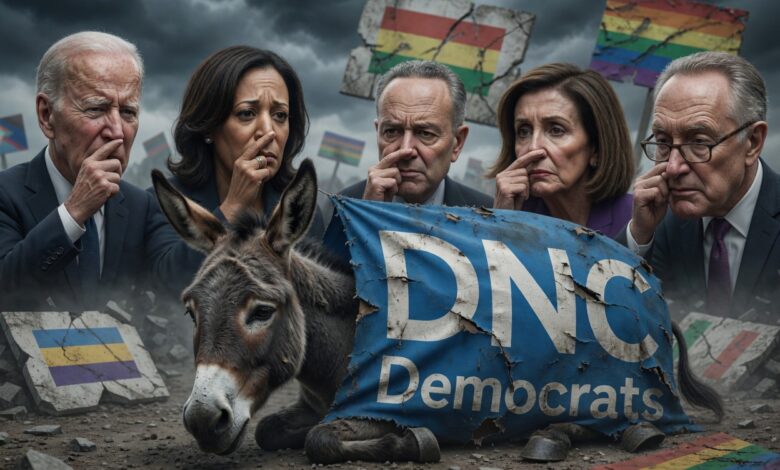
When the Exit Signs Start Looking Attractive
Florida Democrat Lindsay Cross recently decided not to seek reelection. On its own, that’s just another entry in the long catalog of political comings and goings.
Zoom out a little, though, and it starts to resemble something else entirely: a quiet pattern of people stepping away from a brand that still insists it’s thriving.
Politics has always had turnover. What feels different now is the direction of that movement. It isn’t just voters drifting. It’s officeholders, staffers, and insiders recalculating whether they want to stay in the building.
At some point, you stop calling it coincidence and start noticing architecture.
A Party That Keeps Winning Arguments No One Asked For
Spend a few minutes listening to modern Democratic messaging and an odd structure emerges. The party often finds itself defending positions that most voters never raised as questions.
A proposal to improve Washington, D.C. becomes a philosophical debate about intent. A discussion about government spending turns into a seminar on why nobody should look too closely at receipts. A conversation about election security transforms into something approaching moral panic over the idea of asking people to prove who they are.
It creates a strange inversion: instead of persuading the public, the public is frequently treated as something that needs persuading out of its instincts.
That’s a difficult sales model to sustain.
Even more so when the product is government policy.
Voter ID and the Reality Check Problem
Nothing illustrates the disconnect quite like voter identification.
Air travel requires it. Banking requires it. Employment verification requires it. Even buying certain over-the-counter products can involve showing identification depending on the context.
Somehow, the one activity that determines national leadership is treated as the place where verification becomes controversial.
What makes the debate especially unusual is that it isn’t really a Republican idea versus a Democratic idea. It’s closer to a civic expectation colliding with a political resistance.
When polling consistently shows broad public support for voter ID, the argument stops being about ideology and starts becoming about alignment with everyday experience.
At that point, voters tend to notice who is arguing with them.
California as a Long Running Policy Experiment
California offers a different kind of political case study. It functions almost like a closed laboratory where policy ideas are tested at scale, regardless of whether the early results look promising.
High taxes, persistent housing shortages, regulatory expansion, and continuing population shifts have created a feedback loop that would normally trigger reconsideration in most systems.
Instead, the response pattern tends to move in a familiar direction: more analysis, more funding, more structural layering.
It resembles a mechanic insisting the engine needs more diagnostics while ignoring the fact that the car stopped moving miles ago.
What makes California politically interesting isn’t that it struggles. It’s that the interpretation of struggle rarely includes the possibility of ideological correction.
Lindsay Cross, and the Question Nobody Asks Out Loud
Returning to Cross brings the focus back to something more uncomfortable for Democrats.
How many people inside the system are privately reassessing their position?
Public departures are only the visible layer. The more interesting layer is the quiet recalibration happening underneath—staffers, donors, local officials, and rising candidates deciding how closely they want their future attached to the current trajectory of the party.
Political organizations rarely collapse suddenly. They hollow out, then argue about whether the hollowing is real.
The Strange Confidence Gap
A pattern has developed in recent years. Many Democratic positions appear built on the assumption that institutional momentum can substitute for persuasion.
That works until it doesn’t.
Institutional control over media narratives, education pipelines, and bureaucratic structures can create a sense of permanence. But elections eventually introduce a correction mechanism that doesn’t care how confident the system feels.
The public still votes.
Sometimes in ways that don’t match the expectations built inside Washington.
The Voter Loss Story That Keeps Getting Bigger
Reports of Democrats losing millions of voters in recent cycles point to something broader than a single election cycle.
What matters isn’t just the number. It’s the direction of travel across different demographic groups that were once considered stable.
Working-class voters shifting.
Independent voters drifting.
Longtime party identifiers stepping away.
Political analysts often try to explain this through messaging failures or candidate-specific issues, but that misses the larger dynamic. People don’t usually abandon political identities unless something deeper changes in how they interpret the party itself.
That kind of shift is harder to reverse than any campaign cycle.
Republicans and the Strange Habit of Leaving Opportunities on the Table
The other half of the story is harder to explain.
Even as Democrats generate policy positions that often test public patience, Republicans frequently fail to convert that into consistent political advantage.
It shows up in legislative moments like the SAVE Act debate, where strong public support for voter verification runs into fragmented political execution.
Four Republican votes against it don’t just create a procedural outcome. They blur what should be a clear contrast.
That pattern raises a recurring question: whether the problem in Washington is opposition strength, or something closer to institutional inertia shared across the aisle.
When Political Confidence Turns Into Miscalculation
There’s a broader dynamic underneath all of this.
Political movements rarely fail because they lack ideas. They fail when they stop correctly reading the distance between themselves and the electorate.
Democrats, in many cases, still operate as though cultural and institutional influence guarantees alignment with voters. That assumption has become less reliable over time.
History offers plenty of examples of organizations that mistook influence for immunity. Media institutions, corporate giants, and legacy systems have all discovered the same principle: control of the conversation is not the same as control of outcomes.
Eventually, the audience walks away.
The Part Everyone Noticed Except Washington
The most striking aspect of current politics isn’t that disagreement exists. It’s that the disagreement has become easier for voters to interpret without intermediaries.
People can see outcomes directly now.
Economic conditions.
Urban policy results.
Election disputes.
Institutional performance.
That clarity removes a layer of insulation that political messaging once depended on.
Once that layer thins, persuasion becomes harder and reaction becomes more immediate.