

JD Vance Passed the Interview. He Failed the Test.
By Kevin Jackson
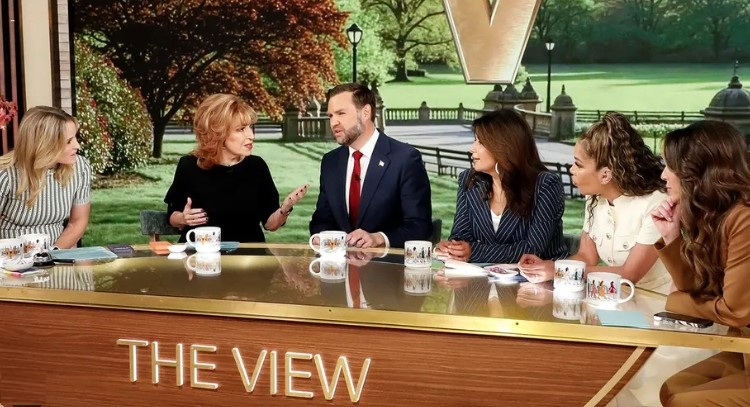
Republicans looking toward 2028 got an early glimpse of something important when Vice President JD Vance sat down with the ladies of The View.
The good news? Vance didn’t get steamrolled.
The bad news? He left points on the field like a quarterback who moved the ball 80 yards and with first and one, took a knee.
Conservatives celebrated because Vance remained calm under fire. And to be fair, appearing on The View is a bit like volunteering to be the designated gazelle at a lion convention. You’re walking into hostile territory where facts are optional, interruptions are mandatory, and applause is often measured by how much Orange Man Bad was injected into the conversation.
But 2028 isn’t about surviving interviews.
It’s about demonstrating presidential instincts.
And on that score, Vance showed he still has some growing to do.
Whoopi Goldberg opened the door wider than a Costco loading dock when she asked, “What did Black people do to this administration?”
🔥 Whoopi Goldberg just tried claiming the Trump admin is CASTING ASIDE black people, and JD Vance is NOT having it
WHOOPI: What did black people do to this administration to make you stigmatize folks of color?!
VANCE: “Look at Washington, DC, one of the most democratic and one… pic.twitter.com/kzLIel1HyY
— Nick Sortor (@nicksortor) June 16, 2026
The premise is that Black Americans are somehow being targeted by President Trump.
That’s not a question. It’s an accusation wrapped in a question mark.
Instead of accepting the premise, Vance could have challenged it directly.
What exactly has the administration done to Black Americans?
Reduced crime?
Expanded employment?
Focused law enforcement on violent offenders?
Secured communities that have disproportionately suffered from criminal violence?
If we’re going to discuss the condition of Black America, let’s discuss actual outcomes rather than emotional folklore.
Then came the claims about Black history being erased, Black representation disappearing, and minorities being stigmatized.
Again, a golden opportunity.
Because one of the great ironies of modern politics is that Democrats claim to champion Black voters while often treating them like political livestock.
Republicans, meanwhile, routinely elect Black conservatives who build coalitions beyond race.
Think about the difference.
Black Republicans don’t need a specially designed political habitat.
He doesn’t require district lines drawn with the precision of a architect. Nor do Blacks need race-based political protection.
Black Republicans compete. They persuade, and win.
The modern Democratic model often looks less like empowerment and more like political zoning.
Assign voters to districts.
Assign representatives to those voters.
Then call it progress. However, many Americans find that insulting.
The conversation should have gone there. Instead, it drifted.
And that was unfortunate because another opportunity soon arrived carrying a gift basket.
The discussion turned toward public safety.
This is where Republicans should be at their strongest.
For decades we’ve heard endless speeches about saving Black lives.
Yet when policies produce dramatic reductions in violent crime, many of the same people suddenly become remarkably quiet.
If a city sees a major decline in violence, that’s not merely a statistic.
That’s fathers returning home. Mothers sleeping through the night. Children growing up.
It’s future birthdays that actually happen.
The phrase “Black Lives Matter” was turned into a corporate slogan. However, saving Black lives should never be a slogan.
It should be a measurable result.
That distinction matters.
Next, Ana Navarro pivoted to detention centers and illegal immigration.
Again, another missed opportunity.
She repeated claims regarding conditions and treatment.
The obvious follow-up question practically wrote itself:
“Have you personally verified those claims?”
That’s not hostility, just setting the record straight.
If allegations are being presented as fact, they should be examined.
Instead, Vance appeared more interested in maintaining a cordial exchange than forcing accountability.
And therein lies the larger issue.
Trump doesn’t enter these environments seeking approval. He enters seeking clarity.
Whether people love him or hate him, nobody wonders where he stands.
Trump understands something many Republicans still struggle to grasp: hostile interviews are not debates.
They are persuasion opportunities.
The audience is not sitting at the table, but instead sitting at home.
The women on The View were never going to be convinced. But some of the viewers might be.
That’s who matters.
Perhaps the biggest missed moment came when Vance referenced child trafficking and missing migrant children.
JD Vance turns the tables on the ladies of The View after they tried to lecture him on how he as a Christian could support deporting illegal aliens:
“Do we know that during the last administration we had tens of thousands of children who were sex trafficked by the cartels?…… pic.twitter.com/TSQ2GFevTM
— Greg Price (@greg_price11) June 16, 2026
At one point, someone appeared to dismiss the issue as belonging to a previous administration.
Think about how extraordinary that response is.
We’re talking about children who disappeared.
Children who may have suffered unimaginable abuse.
Children who should be at the center of any serious humanitarian conversation.
If there was ever a moment to stop the discussion and demand moral consistency, that was it.
The response practically begged for a follow-up:
“So we’re clear. We should be outraged about symbolic grievances, but not outraged about missing children?”
That’s not a partisan question, but a human question.
And it never got asked.
Which brings us back to 2028.
Republicans are beginning to look beyond Trump.
That’s natural.
Every political movement eventually confronts succession.
The challenge for Republicans is that Trump has fundamentally altered expectations.
Voters no longer want Republicans who simply defend themselves.
They want Republicans who prosecute the case.
They don’t want polite explanations.
They want forceful arguments.
They don’t want permission to speak.
They want leaders who seize the microphone.
JD Vance is intelligent, disciplined, and articulate. And he has a compelling personal story.
Those are valuable assets.
But the next leader of the Republican movement won’t be judged against traditional politicians.
He’ll be judged against Trump.
And that’s a brutal measuring stick.
Trump doesn’t merely answer questions.
He challenges assumptions.
He reframes conversations.
He forces opponents to defend their own narratives.
That’s a learned skill.
And Vance still has time to develop it.
The encouraging news for Republicans is that 2028 remains a long way off.
The concerning news for Vance is that the clock has already started.
Because appearing on The View wasn’t the test.
The test was whether he could walk into hostile territory and leave the audience questioning the hosts instead of questioning him.
This time, he survived.
The next time, he needs to dominate.