Put $81 billion on the table and you’d think somebody would at least ask where you’d like to sit.
That’s roughly the gross value of Anthropic’s initial public offering. The company behind Claude priced 980 million shares at $83 apiece ahead of its November 19 Nasdaq debut. About 956 million of those shares are being sold by Anthropic itself. The rest are being sold by existing shareholders, who keep those proceeds. Even after you make that distinction, there’s plenty of money on the table. What isn’t on the table is control.

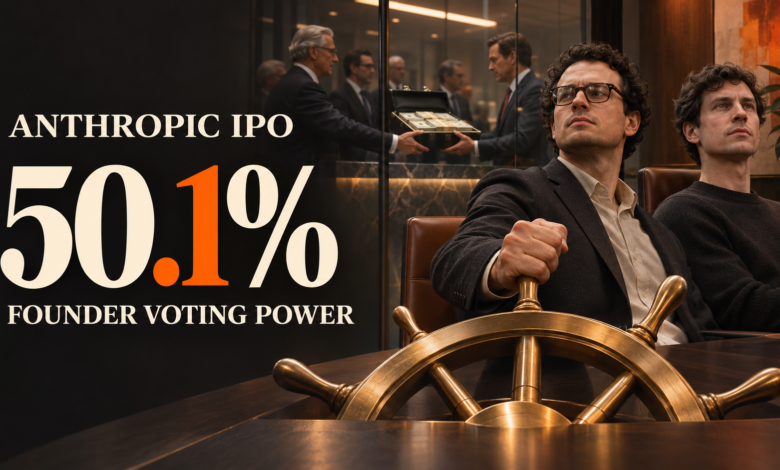
A share of the Class A stock being offered to the public gets one vote. So no, those shares aren’t voiceless. But Anthropic is issuing a special Class F share to an entity organized by its founders. That one share carries 50.1 percent of the voting power on matters put to shareholders generally. It’s the decimal point I admire. Fifty percent leaves room for a conversation. The extra tenth tells you somebody finished the job.
Then there’s the Long-Term Benefit Trust, which has its own special class of stock and generally has the authority to elect and remove the directors who make up a majority of the board. Those are two different mechanisms. The founders get the majority on general shareholder votes. The trust has separate authority over most board seats. You could hold a very well-attended meeting of ordinary shareholders and still not make either group nervous.
I understand why a founder would want this.
If you spent years building a company, you might not want somebody who bought in on Thursday telling you how to run it on Friday. I’ve built businesses. Taking somebody’s money and taking somebody’s advice are two different decisions, although the person writing the check may see that differently. Anthropic put the terms in the prospectus. Nobody owes you a controlling stake just because you like the product.
What makes Anthropic different is what the trust is supposed to protect. The company is a public benefit corporation, and the trust was designed to help it balance that broader purpose with the demands of running a business. That’s not an academic distinction for a company building powerful AI. Imagine management has a model it could ship next month, customers are ready to pay for it, and the safety team says it needs another six months of testing. Now imagine a competitor is getting ready to launch. Whose judgment carries the day? That’s when the governance provisions earn their keep. It’s also when the people who supplied the money learn how much influence they bought.
The trust’s insulation from ordinary shareholder pressure is the point.
If you believe the next quarterly earnings call is a lousy place to settle questions about AI safety, you might like the arrangement. But missions don’t make decisions. People do. When they say they’re acting for the public benefit, I want to know what they weighed, what they gave up, and how they’ll tell if they got it wrong. The fact that I can’t vote most of them off the board makes me more interested in those answers, not less.
Most of the coverage will focus on the stock price, and I get it. A number that moves by the second makes for good television. The price tells you what someone was willing to pay for a piece of Anthropic. It can’t tell you who gets the deciding vote when a decision gets expensive. For that, you have to stop watching the numbers run across the bottom of the screen and read the part of the prospectus that doesn’t move at all.
Anthropic is about to find out what the public thinks its future is worth. What the public gets to say about that future was settled before the first share changed hands.